Apollopsychē Melitaea follows proprietary mathematical algorithm in joining The Dance of Psyche in Greektown Chicago
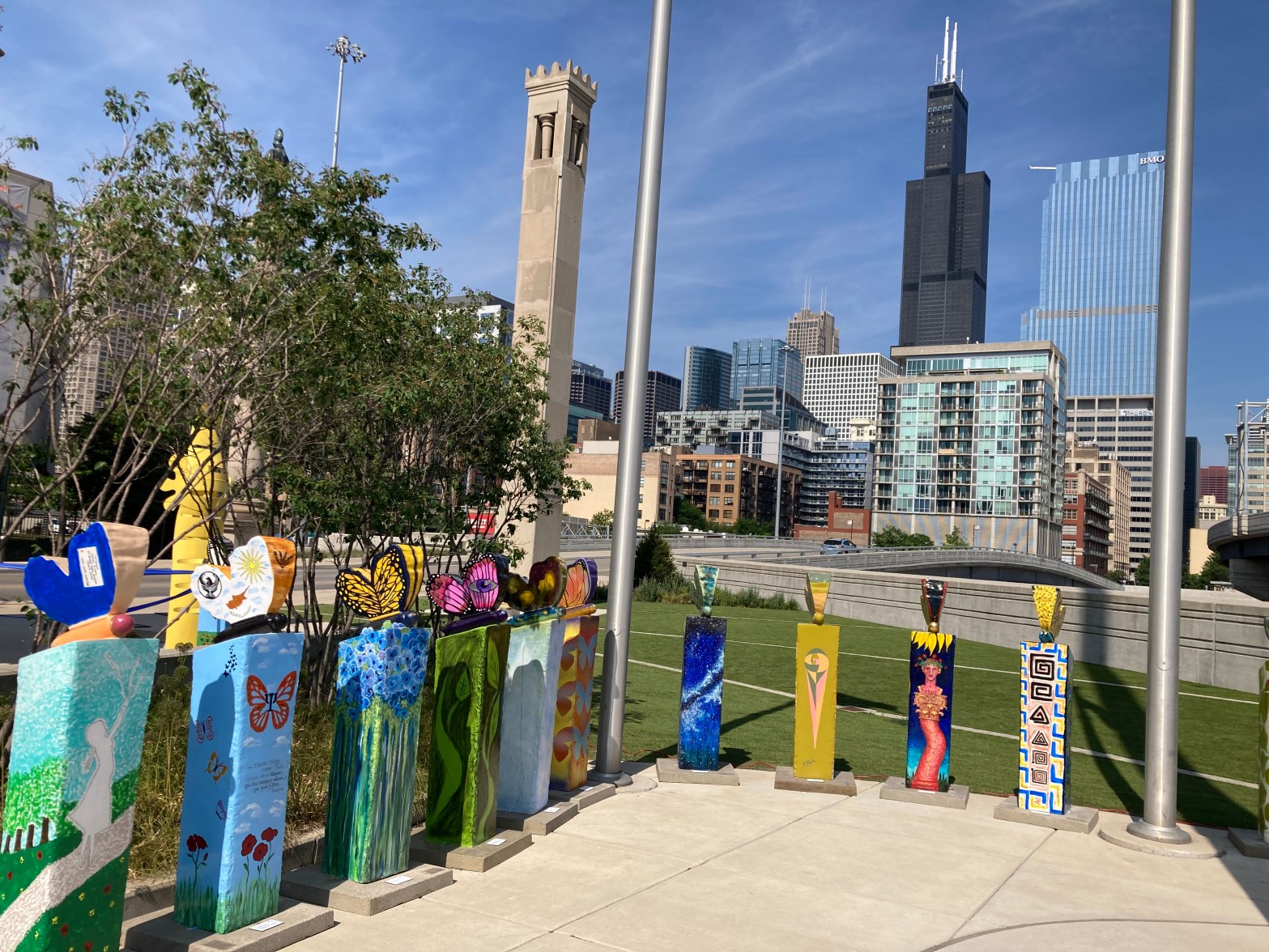
The Dance of Psyche, 2023 outdoor butterfly sculpture exhibit in Greektown, Chicago
[CHICAGO, IL, USA; June/July 2023] Scientiquity staff report
You’ve heard of paint by number, but how about number painting art? That’s exactly what Scientiquity has accomplished in its latest piece!
Apollopsychē Melitaea, the title of Scientiquity’s 2023 outdoor sculpture, is a conjunction of the Apollos butterfly species, the Greek god Apollo, Psychē the Greek goddess of the soul, and the butterfly species Melitaea cinxia.
Scientiquity chief polymath artist Terry Poulos was selected for the sixth consecutive year to paint a pre-fabricated sculpture for the Greektown Chicago outdoor art exhibit, titled The Dance of Psyche. The annual exhibition is designed to beautify the streets of Greektown Chicago, provide thought-provoking works of art which brighten the daily commute for pedestrians, and if fortunate enough, educate.
One of the four sides of Apollopsychē Melitaea by Scientiquity. The geometry is reminiscent of Picasso and cubism
The current exhibit is described by the Greektown Arts Committee as “a kaleidoscope of butterflies titled The Dance of Psyche with 26 vibrant three-dimensional sculptures that showcase the creativity of 13 professional or emerging artists, 2 Chicagoland high schools and 11 local Greek language schools.”
Apollopsychē Melitaea encapsulates the butterfly as a symbol for the union of male/female, as containing the soul of humanity (a common theme in butterfly mythology), and the fractal nature of life. When Glanville fritillary (Melitaea cinxia) caterpillars were introduced to the island of Sottunga in the Åland archipelago, it unexpectedly resulted in three additional species, “which sprang out of the butterfly like Russian dolls,” according to Atlas Obscura.
Another side of Apollopsychē Melitaea, featuring Scientiquity’s proprietary Sierpinsky fractals
This is the essence of fractal geometric series iteration and ‘the many from the one’ paradigm of Standard Model Big Bang cosmology. Furthermore, the female butterfly of the Queen Alexandria species features hind-wings with triangular patterns, and as such the sculpture depicts the artist’s very own proprietary Sierpinsky triangles, another ode to fractal geometry. Lastly, the physics of butterfly flight emanates from – among a variety of mechanisms – its aerodynamics which are generated by force via wake capture, vortices at the wing edge, and rotational dynamics. Hence, the artist filled his sculpture throughout with images of spiral fractal repeating geometric sequences.
The artist will be publishing an academic paper summarizing the mathematics of his proprietary schematics, which are geometric sequences serving to naturally render the painting for the artist. Number painting art, opposed to paint by number.
Third side of Apollopsychē Melitaea by Scientiquity, showing fractal spheres. Location: Northeast corner of the Intersection of Halsted & Jackson streets in Greektown Chicago
The entire arts project itself “is rooted in Greek culture, mythology and geography,” writes the Committee. “Psyche is the goddess of the soul; Aristotle gave the butterfly the name “psyche” (the Greek word for soul); and the Greek island of Rhodes is famous for its Butterfly Valley (Petaloudes), a lush nature preserve.”
As always, Scientiquity spins its own additional brand of math and science themes into all its works of art.
Fourth and final side of Apollopsychē Melitaea by Scientiquity. Symmetry relations
The Greektown Arts Committee is headed by arts patron and Greektown business owner Eve Moran, who also designed the prototype for the sculptures.
Terry Poulos is a Chicago-area writer, archaeological historian, artist and geometer whose investigations focus primarily on physics, fractal topology, and Number Theory
Metaphysical landscapes by polymath John Fotiadis exhibited at National Hellenic Museum. Architect, artist, musician touches on sacred geometry, symmetry, the substrate of our 3D frame, atomists, resonance, teleology, ontology, more
By Terry Poulos, Scientiquity founder
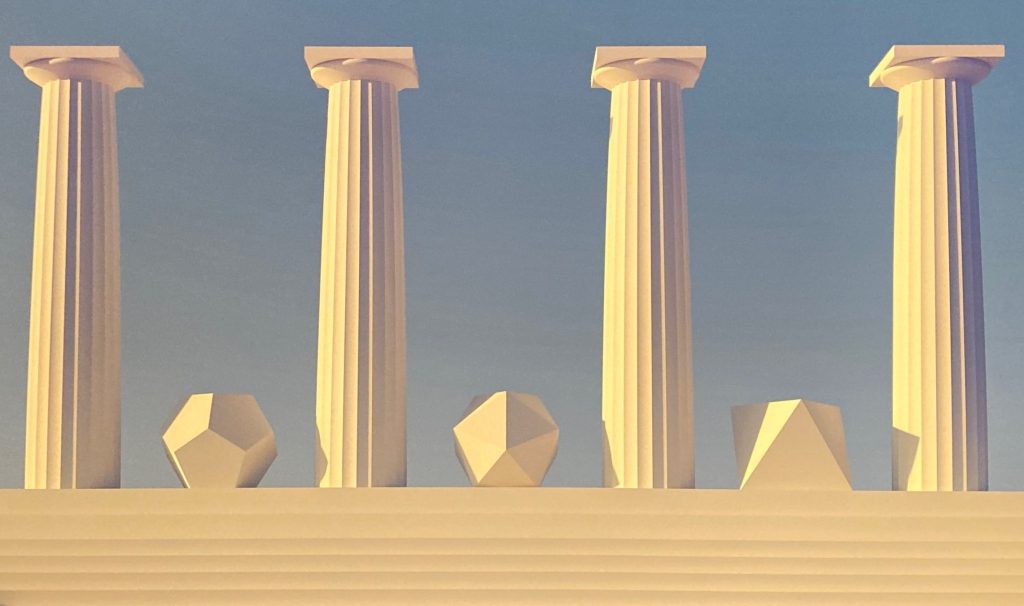
One of the series called “Metaphysical Landscapes.” Blending an architect’s drafting skills with computer-assisted imaging, Fodiatis is able to masterfully capture light, shadow and color in conjuring his altered status of Platonic solids mixed with pristine Grecian architecture. Image credit: John Fotiadis
[CHICAGO, IL, USA 6/19/2023] In physics, the Principle of Least Action informs of nature’s wont of efficiency, that systems tend toward expending the least amount of energy necessary to perform a given task. It’s nature’s elegance through simplicity, now believed to transcend all the universe from quantum to classical scales.
Greek American architect, artist, and musician John “Yanni” Fotiadis embodies that principle in designing buildings and landscapes, in creating art, and music. In “Beyond Antiquity,” a series of nearly 40 pieces on exhibit this Summer at the National Hellenic Museum in Chicago, Fotiadis takes us on a tour-de-force of clean, pure, radiant, and brilliant metaphysical landscapes, a hybrid of ancient-to-modern blended images from classical antiquity to present day.
The artist mixes raw hand-drawn art with cutting-edge multimedia and computer-assisted image creation to present magnificent archaeological ruins, Platonic and Archimedean solids, and modern-day landscapes in a seamless optical feast reaching beyond the surface to evoke a visceral mind’s eye subconscious reaction.
Fotiadis “explores classical antiquity in Greece and takes us into the present and future via the same subjects: architecture, myth and landscape,” reads the museum’s summary. “Classical antiquity is omnipresent in Greece, where you can glance up from a cosmopolitan street in Athens and see the 2500-year-old Parthenon. The ancient past is woven into the cultural legacy of the country physically, psychologically, intellectually and emotionally. It is an immense, epic and unavoidable presence that inspires all of Fotiadis’ art,” concludes the promotional message.
“It is no coincidence philosophy was born in this part of the world…The natural environment of Greece is an environment ripe for expanding thinking…”
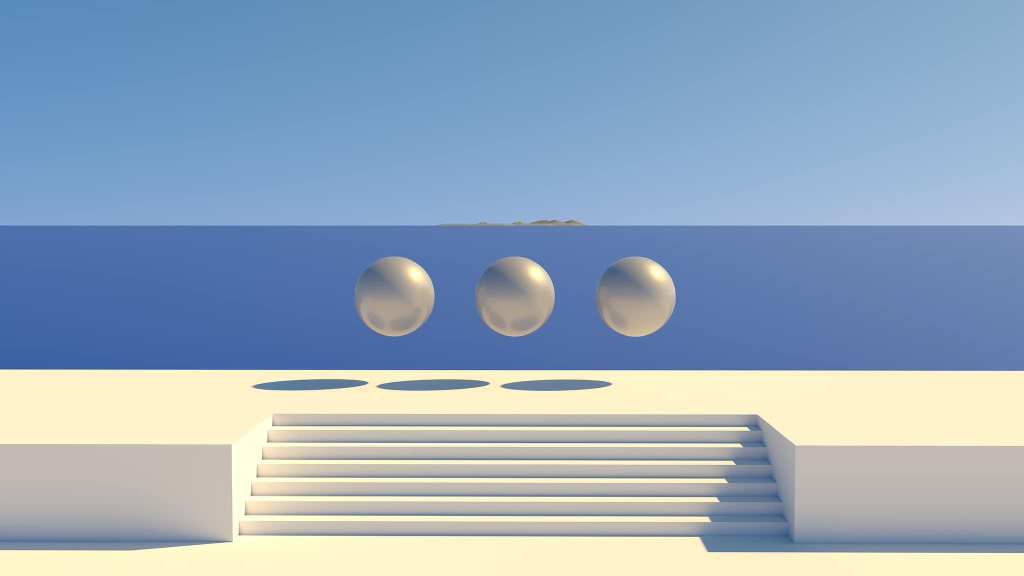
“Metaphysical Landscape #19 – Between The Realm of Gods and Men,” by John Fotiadis. 2022. 10000 x 4626 pixels. Rhino -> VRay -> Photoshop. Image credit: John Fotiadis
“It is no coincidence philosophy was born in this part of the world,” wrote Fotiadis, who currently resides in New Jersey in the greater expanded Manhattan region. “The natural environment of Greece is an environment ripe for expanded thinking…Creating these artworks has taught me that one can find the ‘divine’ in anything, even the most banal object, under the right conditions and if one looks hard enough. I find myself returning again and again to the bottomless well that is ancient Greece.”
We spoke with Fotiadis, who’s a polymath not only with his hands and geometric perspective, but also has a firm grasp of philosophy and history. The topic of artificial intelligence came up. Fotiadis has been experimenting with the program Midjourney and other 3D design software to further blend and expand his artistic toolbox. But he also recognizes we’re in the midst of a great technological explosion and disruptive Renaissance.
“To look ahead, to survive, I believe we must examine and learn from the past. I feel that is the only way we will move beyond antiquity, and beyond our present state, towards a better future.”
“Now more than ever,” he explained, “as we face a rapidly changing and virtually unrecognizable, technologically driven world, I find it a source of comfort, reassurance, guidance and most of all, knowledge and wisdom. To look ahead, to survive, I believe we must examine and learn from the past. I feel that is the only way we will move beyond antiquity, and beyond our present state, towards a better future.”
Fotiadis, as delineated in the museum’s literature, labels his latest creations “Metaphysical Landscapes, a collection of digital images that show imaginary environments inhabited by Platonic solids and classical architectural forms, arranged in such a way as to capture or speak to the transcendence that is evoked when Greek architecture, deliberately placed in the landscape, begins to resonate with its surroundings.”
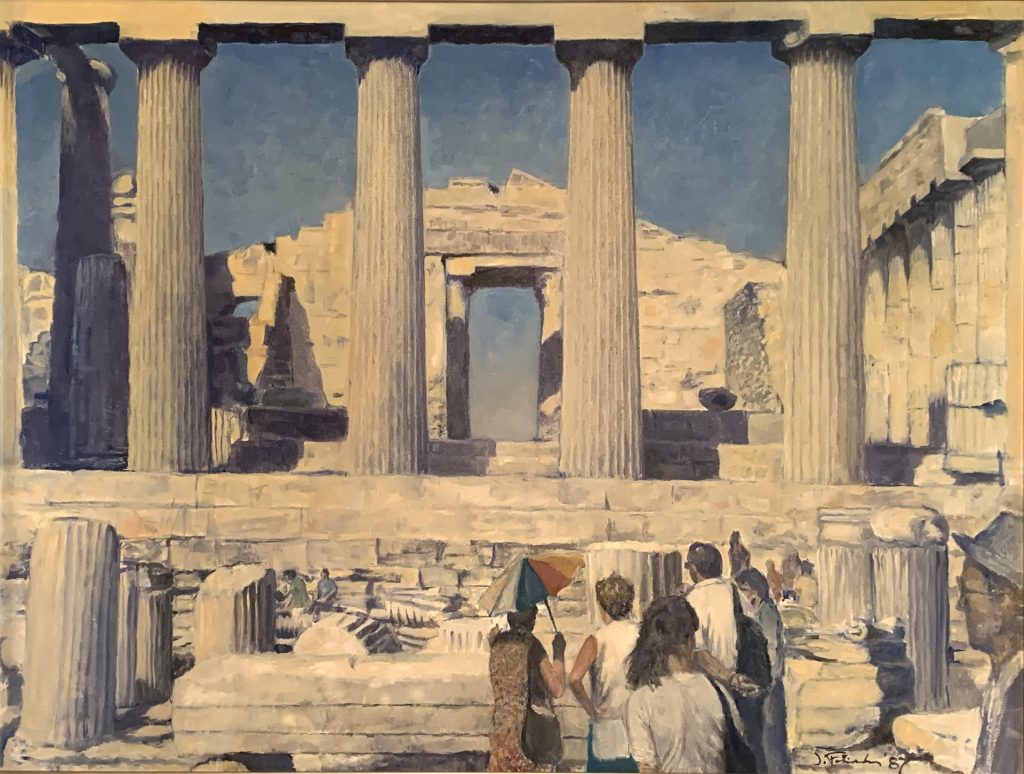
Tourists At The Eastern Facade Of The Parthenon. 36″ x 48″. Oil On Canvas. 1987. Credit: John Fotiadis
Fotiadisstudied architecture at Temple University and Columbia University, earning a Master’s degree. In a 30-year architectural career, he has designed projects for clients in Doha, Seoul, Dhaka, San Francisco, Cairo, Moscow, Panama, Kyiv, Tbilisi, Athens, Dubai, and Istanbul. This has afforded him a global perspective on optics, architecture, philosophy, culture and art.
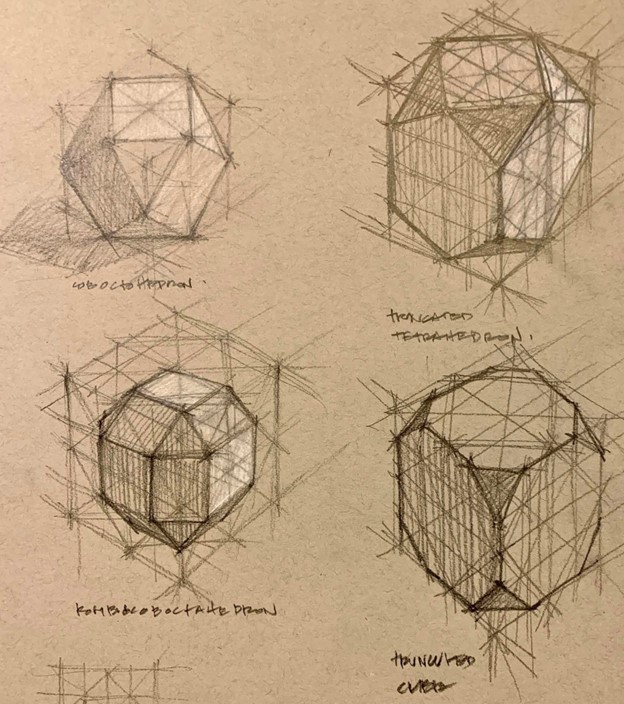
Like most artists (and scientists), Fotiadis keeps a notebook of esoteric sketches combined with life-like images and notes and observations. His latest codex began in 2019 with a series called “The Solace of Antiquity.” He works with graphite, colored pencil and charcoal to “document the ruins of ancient sites, and explore the effects of the luminous Aegean light on the architectural remnants there,” writes Fotiadis.
A page from the latest `Fotiadis Folio,’ a journal or codex of geometric and at times esoteric sketches by the artist. One can’t but help conjuring images of an Archimedes, Euclid or da Vinci steadfastly at work. Image credit: John Fotiadis
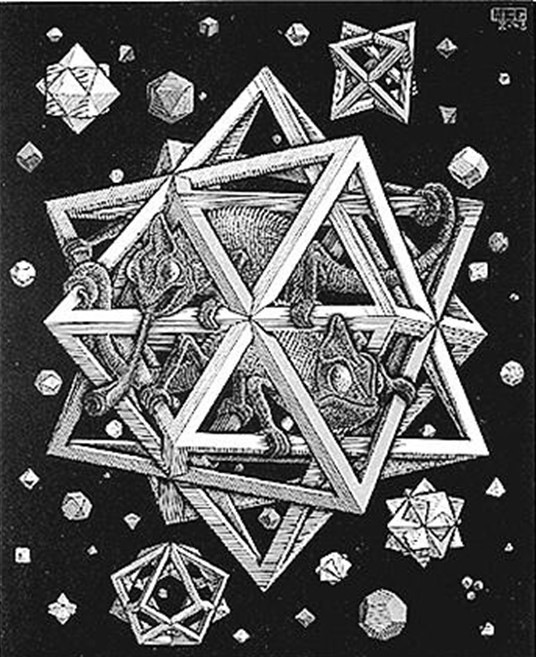
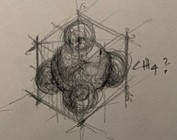
“I also became a bit obsessed with one of (artist) M.C. Escher’ssolids – a compounded form of 3 octahedrons. This form like so many other Archimedean solids, is derived from a cube,” he explains. “I smiled to myself when I saw the `CH4′ in one of the sketches next to the tetrahedral-shaped form which I remembered from chemistry as also being the shape of the methane molecule. The idea of an order that underlies the universe and which is most clearly evidenced through the study of mathematics, is an idea that goes all the way back to Pythagoras.”
“Stars” by M.C. Escher. A compound of three octahedrons. Image credit: Wikipedia Commons
While the Platonists were into Form and pure geometry, the Pythagoreans by some bit of contrast were more students of the `music of the spheres,’ believing all things to be number, and that the universe was itself made of vibrating strands. While playing the ancient Greek stringed instrument called the Lyre, this cult of mathematics discerned that certain notes – a third, a fifth, etc. – were most pleasing and in resonance with the human ear. They considered these ratios to be sacred and that matter itself were comprised of vibrations of such elements, foreshadowing modern-day string theory.
And what does Fotiadis do in his spare time for fun? He’s a singer and guitarist in a rock band. Even the great Leonardo da Vinci couldn’t top that bit of `polymathical’ resonance.
On that “note,” we move to our Q&A portion of the interview, where we cover ground from architecture to geometry to quantum particles, philosophy, harmonic resonance, ontology, and more.
_______________________________________________
SCIENTIQUITY How do you balance elegance through simplicity in architecture and art with the wont of being creative and conjuring up new, unique designs? How do you, as an architect, push the envelope while simultaneously maintaining integrity and utility of structures?
FOTIADIS Regardless of the design problem, I always remember a phrase I learned in Italy years ago – “sempre elegante” (always elegant). That is, regardless of the task at hand, remembering basic compositional principles of harmony, balance, proportion, etc. and keeping those top of mind when I design – be it a new artwork or a building, will go a long way. I’ve never believed in the idea of making something deliberately ugly for the purposes of some subversive narrative or subtext which you see of a lot in art today.
Metaphysical Landscape #2: Mixed media, new media. Credit: John Fotiadis
SCIENTIQUITY Each client has their own tastes and needs. Can you point to a cultural preference among the many clients you’ve worked for in terms of simplicity and complexity and more fine detail? Some like perfectly symmetric repeating patterns, some like intricate, weaving patterns which might be more abstract and asymmetric.
FOTIADIS Most clients I’ve dealt with come to the table with a predetermined image in their mind. Since the advent of the internet, clients have access to millions of images which they find appealing, trendy, fashionable, etc., but without really understanding the context from which that imagery is taken and why it looks the way it does. You can’t design a Mediterranean villa in a cold climate. I suppose you can, but you won’t get much use out of it most of the year. I can no longer identify cultural preferences because to a large degree in the world of design – culture, like national sovereignty, is slowly being eroded. To be honest, most of the clients I’ve dealt with were corporate. Primarily real estate developers. They are driven by what the market is demanding. The challenge working with them is always striking a balance between their economic goals, while simultaneously meeting their desire for a striking image for their project – intended to make an impression or reinforce a brand identity. One of the reasons I stopped working as a practicing architect and now only provide consulting services, is due to the fact most clients wanted me to give them a copy of something they had seen. Very few asked me to solve a design problem and provide an innovative solution.
SCIENTIQUITY To your own taste, which is more beautiful: Perfect symmetry, or slightly asymmetric locally but symmetric globally? Or chaos and randomness? I’d think that wouldn’t fly too much with building design.
FOTIADIS It depends on the subject and context. An idea like symmetry conveys other deep ideas such as order, balance, logic. Personally, I find ideas expressed visually in this manner comforting. But sometimes the function of a building or form may not be symmetrical due to its purpose. This is an idea that has been at the core of modernism since its inception. That is, the idea of an honest expression within the design which may not result in an order clear configuration (such as a symmetrical façade for an asymmetrical building behind it). Like everything else, I think one needs to strike a balance.
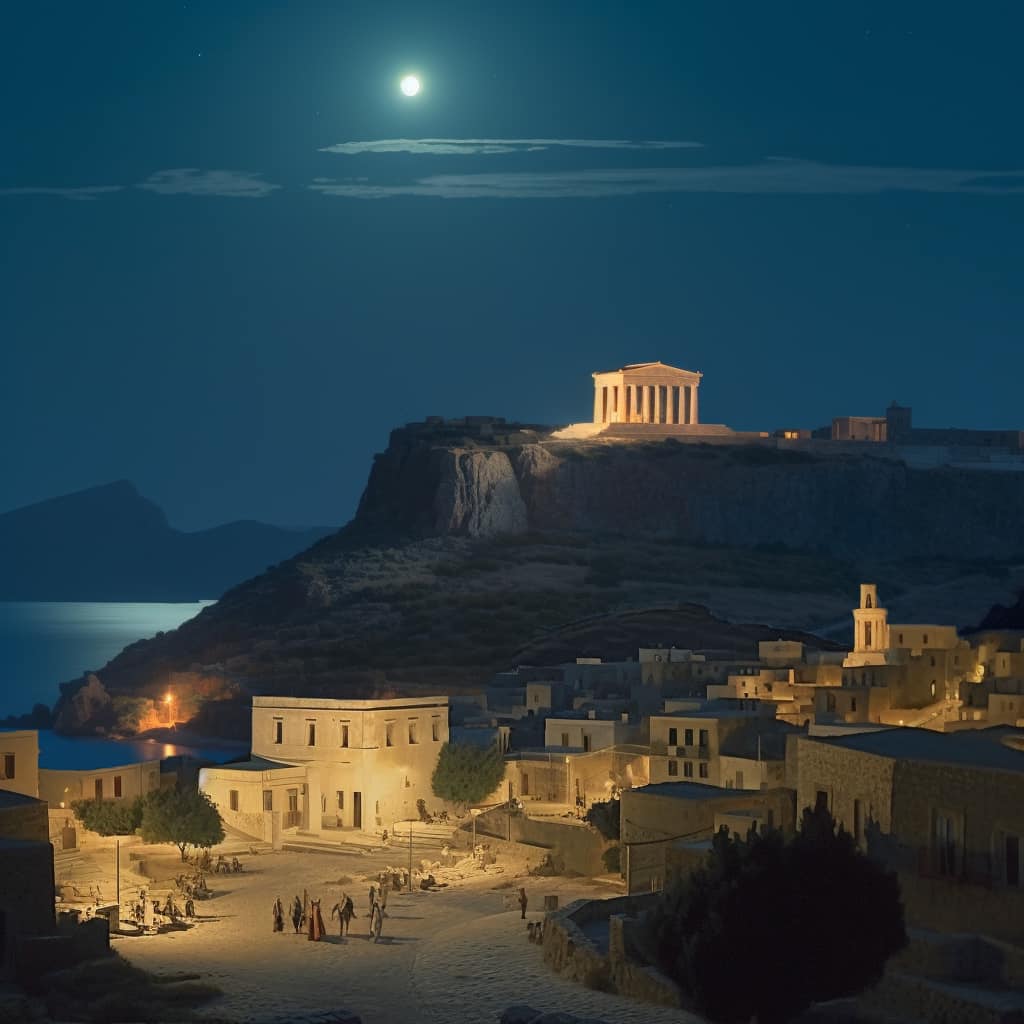
The artist’s latest, experimentation with AI program Midjourney. Credit: John Fotiadis
SCIENTIQUITY Who’s your favorite ancient Greek scientist, mathematician, and/or philosopher and why? Your work could be interpreted as a hybrid of Plato, Euclid and Archimedes.
FOTIADIS I have many favorites for different reasons. But In the final analysis it is Plato. Followed by Aristotle. Between the two of them they went very far in positing the true nature of the cosmos and humanity’s place in it. Their achievement is superhuman, absolutely staggering and unprecedented. Every philosopher and scientist who has followed since has followed in their wake. Their importance to the core understanding of humanity itself and the universe cannot be overstated.
SCIENTIQUITY Plato’s forms are ideals. We now know that, as you get smaller and smaller on the quantum scale, things tend to get more rough, or course grained. The ancient Greek atomists thought matter to be comprised of an array of bit-sized, discreet points.
FOTIADIS The Greek word “atom” literally meant that which can no longer be divided or cut into smaller components. In other words, a finite object or point. But from my understanding of physics, that point has not been reached as science continues to discover smaller and smaller components of matter. That in turn raises an ontological and philosophical question as to whether there is a finite point. It seems the universe works in scalar fashion in the opposite direction as well. Is it infinite? Is spacetime infinite? Can something always be, that is, exist without beginning or end? I don’t have the answer but I am beginning to think the reason why I don’t is because we as a species do not have the intellectual capacity to truly understand the authentic nature of “reality,” even if it were revealed to us. We call reality that which we can observe or theorize about (which in turn is also based on empirical observation). But one must ask, what about all that we CANNOT observe? Plato seized upon the idea of flawless beautiful geometric forms which are so perfect that one might speculate they were not invented but rather, discovered, and have always existed. The same can be said of mathematics.
SCIENTIQUITY What does your intuition say? Is the substrate smooth or granular or a bit of both?
“…an omnipresent energy which could be construed as “consciousness” and vice versa depending on the density that consciousness may manifest into physical matter.”
FOTIADIS My intuition tells me that at that scale we are talking about, there exists an omnipresent energy which could be construed as “consciousness” and vice versa depending on the density that consciousness may manifest into physical matter. The answer, probably, is all of the above.
SCIENTIQUITY Is geometry the “stuff” we are made of, or more a product and consequence of an underlying ever more fundamental reality? Or a bit of both? Everything acting together in cohesion, or as they say holism.
FOTIADIS I suspect that like mathematics, geometry is not an invention. Rather it is a discovery. It has its own autonomous rules and logic. To me it represents a much more fundamental aspect of reality of which humanity has only just begun to understand.
SCIENTIQUITY Is reality point-like, or is it diffuse and blurred? Overlapped and entangled as in the quantum scale, or binary and predictable and “each thing its own” like the zeros and ones of a computer?
FOTIADIS Physics has implied via very crude experiments, that on a quantum level parallel and simultaneous realities might exist. Perhaps it is our limited perception that forces us to consider reality as a linear phenomenon, indelibly connected to time and linear in nature.
SCIENTIQUITY The jury is out still. Einstein said he could never abide a universe which did not follow some rules of cause and effect, ergo predictability, ergo elegance and structure or order.
“There is a teleological aspect to this idea which makes sense. The Gnostic and Neoplatonist philosophers believed in an aspect of the same phenomenon operating at different scales – “As above, so below”. I tend to agree and believe that there is a broad and underlying purpose and logic to existence, and therefore reality.”
FOTIADIS It was Aristotle who posited a reality as having “purpose”, in that everything in existence is operating to reach its full potential. This was based on his empirical observations of the natural world. There is a teleological aspect to this idea which makes sense. The Gnostic and Neoplatonist philosophers believed in an aspect of the same phenomenon operating at different scales – “As above, so below”. I tend to agree and believe that there is a broad and underlying purpose and logic to existence, and therefore reality. What that is, however, is beyond me.
SCIENTIQUITY String theory, today’s most widely studied so-called `theory of everything’ and theory of fundamental particles and quantum gravity, may have been foreshadowed by the Pythagorans, whose motto was “all is number.” They believed certain numbers, primes, to be the building blocks, and that certain numbers and sequences as an integral vibrated together to form the structure we experience in our 3D classical spacial frame. They studied this using stringed musical instruments. As a musician and geometer, what is your take? Does your intuition say our 3D classical frame is merely the full-scale rendering of a 2D more linear surface projection, or is the 3D spacial reality fundamental on all levels?
FOTIADIS All IS number. I agree with Pythagoras (as I suspect, did Plato), because numbers have an impenetrable and incorruptible truth and elegance as to how they operate. An absolute undeniable truth. I believe Mathematics is the language of the universe, the language of existence. While we tend to reflexively believe we inhabit a three-dimensional world – perceiving space around us – I believe that we inhabit at least 4 dimensions – if one factors in time. Our frame might be a rendering of something far more complex once one is willing to think of time as a non-linear unidirectional phenomenon.
“…our physical bodies and all the senses that come with them, are largely the evolutionary product of existing on this planet – with its very specific gravity and densities of matter, which in turn shaped our senses and abilities to perceive”
SCIENTIQUITY What is it about ratios such as 1/3 and 1/5 which when struck on a chord, produce such pleasant sounds to the human ear? Are we “fine-tuned” to the resonance of earth at least, and the larger universe also?
FOTIADIS I believe – aside from our consciousness which I have come to believe is separate from our physical being – that our physical bodies and all the senses that come with them, are largely the evolutionary product of existing on this planet – with its very specific gravity and densities of matter, which in turn shaped our senses and abilities to perceive. The foundation of all music (at least in the west) is rooted in chord voicings that include the third and the fifth notes on the scale. Together with the first note they comprise a triad, which in the world of geometry and mathematics could be represented by triangular or tetrahedral forms. Three sided, equidistant, equal angles, equal lengths, etc. forming the foundations of new whole forms which we have come to understand are inherently stable. The human species perceives these intervals of notes as resonant, NOT dissonant. Whether they are that way in the rest of the universe is unknown.
SCIENTIQUITY You mentioned how looking to the past grounds us, so to speak, and maybe prepares us for the innovation of the future. Tell us how AI is wowing you, frustrating you, scaring you, and helping your art and architecture work as well.
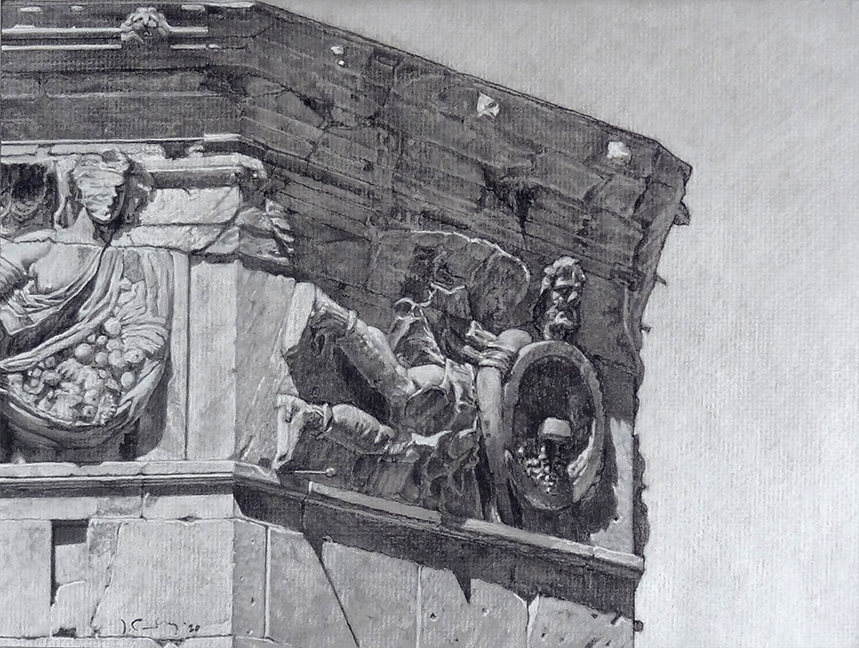
The Tower of the Winds (“Αέρηδες”). 12″ X 19″. Charcoal on Graytone Paper 2020. Credit: John Fotiadis
FOTIADIS I’ve been immersed in AI for the past month, experimenting with primarily visual AI engines like Midjouney. At its core it seems to be an incredibly powerful amalgamation of algorithms and data sets, that combined can create compelling (but albeit inaccurate) visual imagery. I have seen AI’s limitations (for now). But I suspect that as it continues to develop, the inaccuracies will become more finite until they are eliminated altogether. To understand artificial intelligence, one must first understand intelligence. And that is the intellectual capacity we have in order to absorb a bombardment of information in the form of images, sounds, sensations, etc, and order that place data into cohesive sets and thoughts that in turn create an armature of reality in our minds that we perceive and experience. Soon AI will reach a point where it will create images and experiences which will no longer be distinct from reality. That in turn will force us all to question what reality really is. Is it simply our perception? Is the reality we inhabit simply one of MANY realities? The ancient Greeks pondered reality and posited a number of different approaches to understanding its essence. I take comfort in knowing that the same ontological questions that keep me awake at night when the rest of the world is sleeping, are the same ones that went through the minds of men two and half thousand years ago in the Eastern Mediterranean.
SCIENTIQUITY Tell us about cubes, a fascination of yours. For instance, they can be reduced to six square sides, and each of those can be reduced to two right triangles. Are cubes as fundamental as right triangles, or are the right triangles the building blocks of cubes?
More from the Fotiadis Folio: The artist creating a toy model of the c4 configuration, pertaining to the Methane molecule. See following question below
FOTIADIS To me the cube is an excellent starting point. In “Timaeus”, Plato calls it the element of Earth. It is inherently a 3-dimensional volume, not a 2-dimensional form like a right triangle – almost a different geometric species – but nevertheless related. As such the cube immediately becomes the starting point of many different bilaterally symmetrical three dimensional permutations in three dimensional space. The forms which we perceive on a daily basis in our physical world. I’ll spend evenings drawing a cube over and over and seeing what I can derive from it. A wonderful permutation is the “Escher solid”, a rhombic dodecahedron the artist MC Escher derived and featured in several of his artworks. While the right triangle probably goes back to the Babylonians, the cube – to me at least – seems somewhat timeless and universal.
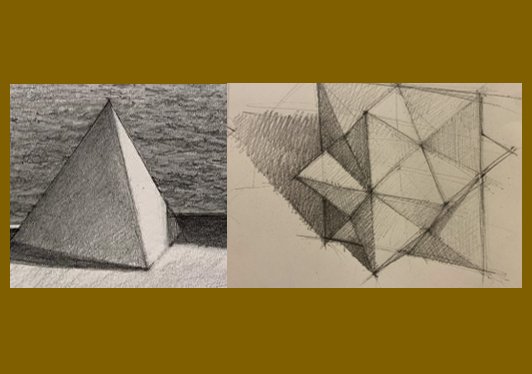
From the artist’s folio: A study in tetrahedrons. At left is a single tetrahedron, with four faces (the base is the fourth but any of the four faces can be rotated to be the base). On the right is a series of coupled tetrahedrons. Credit: John Fotiadis
SCIENTIQUITY Expound upon the Methane molecule, which has a tetrahedral lattice, and how this relates to geometry in general, and as a possible substrate for our classical world experience. And how may this have inspired some of your art.
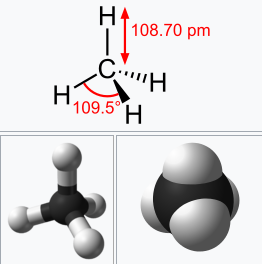
Methane molecule with four hydrogen atoms and one carbon atom arranged in a tetrahedral lattice. Image: Wikipedia
FOTIADIS The CH4 molecule is basically one carbon atom bonded with four hydrogen atoms in a tetrahedral configuration. I was fascinated by how this molecule is symmetrical on all sides. To me it is atomic perfection. Overlaying cubes with various angled lines, I realized that a regular tetrahedron can be created with the diagonal lines traversing the opposite faces of the cube. When I see stuff like this, I can’t help but feel that there is a broader underlying logic to how matter interacts and thus creates our reality. It is rooted in geometry, again number.
Exhibition: Beyond Antiquity at the National Hellenic Museum. Summer 2023
16 artists recognized at National Hellenic Museum for outdoor art exhibit
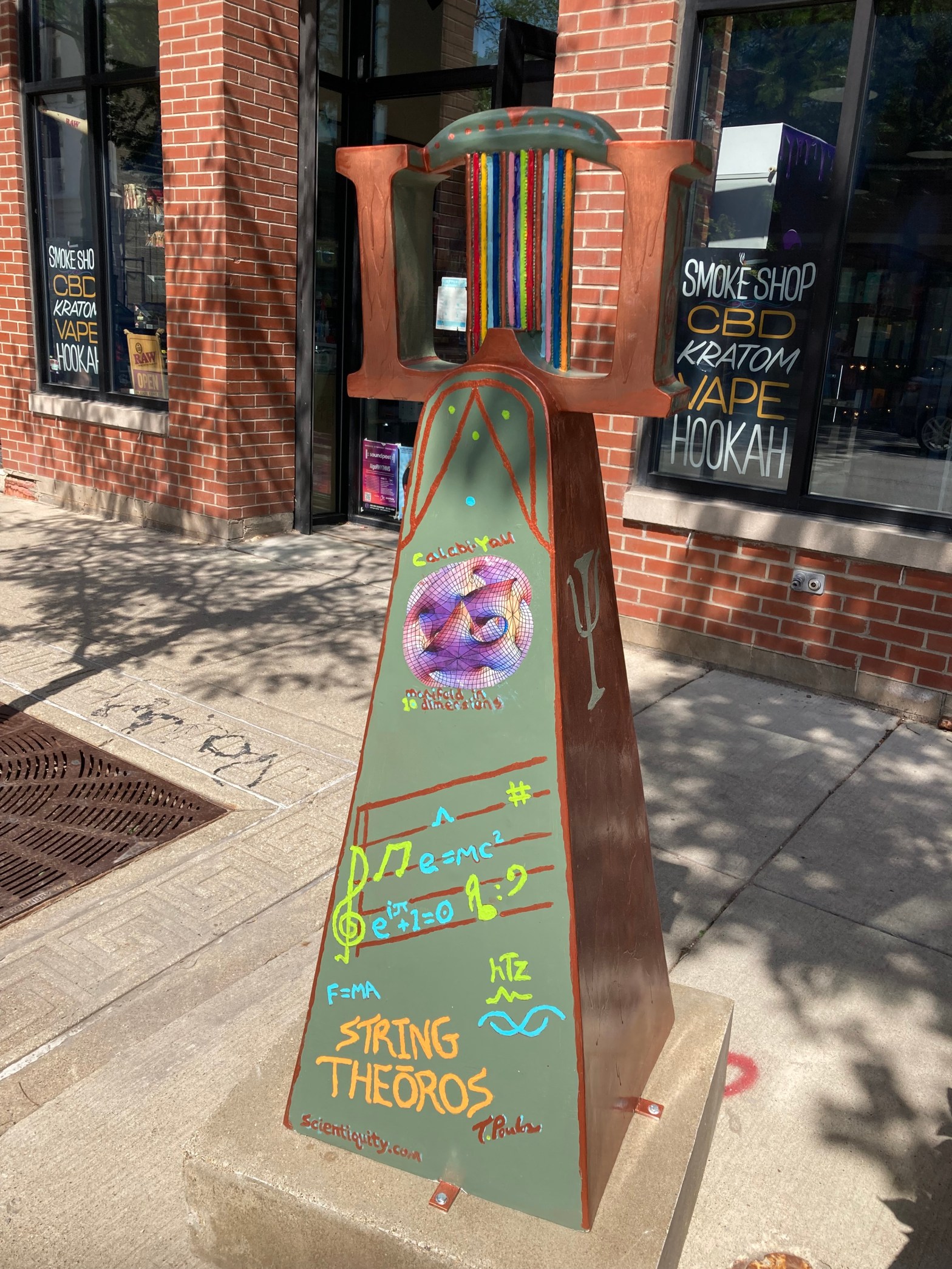
String Theōros on Halsted Street in Chicago
By Terry Poulos, Scientiquity founder and polymath artist
[CHICAGO, IL USA; 07/02/2022] Scientiquity artist Terry Poulos along with 15 other artists were recognized at the National Hellenic Museum during a ribbon-cutting ceremony held this past Thursday announcing this year’s annual Greektown outdoor art exhibit, titled “The Painted Lyre.” The lyre is a stringed instrument dating back to ancient classical Greece which was played similar to a harp or guitar.
Poulos, who creates art under the Scientiquity brand (the science of antiquity), submitted “String Theorōs,” which is intended to educate on the basic tenets of String Theory in theoretical physics. String Theory for the past 30 years has been one of the most studied and well-funded potential so-called “theories of everything.”
One of 16 artists selected to paint the hollow, prefabricated fiberglass mold, Poulos has now been part of this exhibition – an annual affair- for six consecutive years. The art is designed to beautify the streets of Greektown Chicago, and provide thought-provoking works of art which brighten the daily commute for pedestrians and hopefully bring patrons to the neighborhood. The various pieces line Halsted Street in downtown Chicago between Van Buren on the south and Madison on the North.
String Theorōs features a hybrid blend of musical symbols along with various equations and symbols used in physics.
Reverse side of String Theōros
On the flip side, there is an image of Pythagoras of Samos, an ancient Greek philosopher who legend has it founded a secretive cult of scientists and mathematicians who strongly believed that all truth can be found through mathematics. And that math and geometry (including the right triangle and Pythagorean theorem on the sculpture) underlie the entire structure of the universe.
Moreover, these early theorists were adamant that specific ratios held mystical powers, such as the spacing of the musical tones on stringed instruments that represented the notes a third or a fifth, for two examples. These notes, it turns out, are indeed most pleasing to the human ear, and the Pythagoreans – almost religious-like – thought they were sacred.
As for music, in physics, when sound reverberates through the medium of air particles, it creates a type of vibration, what scientists call a “resonance.” This phenomenon is related to electrons and the force of electromagnetism. On the sculpture, Poulos represents this from the redshift wavelength (a motorcycle’s wailing sound tailing off as it moves away from the observer) to the blue end of the spectrum (volume increasing as the motorcycle moves toward the observer). Poulos attempts to portray this action by painting a rainbow on the lyre’s strings, a metaphorical full “color” electromagnetic spectrum. Furthermore, the artist depicts various equations put forth by James Clerk Maxwell, who formalized the equations of electromagnetism.
Also appearing on the sculpture is a widespread artistic theoretical interpretation of a so-called Calabi-Yau manifold, the alleged six hidden dimensions of string theory which are claimed to be so compact and found at energies far too large to be detectable by our current high-energy particle accelerators. As string theorists are fond of saying, the math works and all four forces – electromagnetism, the strong and weak forces, and gravity – are unified in 10 dimensions.
However, the proof for string theory – or superstring theory and supersymmetry – has yet to be exhibited in empirical experimentation. For now, all we know of are the three familiar spacial dimensions (latitude, longitude, altitude for simplification) along with the additional configuration or coordinate of time. 4 + 6 (Calabi-Yau) = 10. Then there’s 11 dimensions in M-Theory and 26 in Bosonic String Theory. We’ll leave those for another post.
Einstein’s Special and General Theories of Relativity informed us of the three spacial and one time dimension and the curvature of space. By dimension, he meant four degrees of configuration, and that space and time were integrated, inseparable. With this knowledge, Poulos decided no theory of resonating strings (as an ultimate theory of everything) would ever be complete without folding in Einstein’s famous equation for energy/mass equivalence, that energy equals mass times the speed of light squared. Einstein’s most famous equation for gravity (the geometrical bending of spacetime) is also depicted on the painting.
Related images are from Sir Isaac Newton’s 2nd Law, the force/mass and acceleration equivalence, that force equals mass times acceleration. The artist further includes Leonhard Euler’s famous “Euler’s identity,” often called “the most beautiful of all equations.” The constant, infinite number E is used heavily in economics to compute compound interest, for one example. It’s approximately 2.71…, and when raised to the power of i (the imaginary unit, commonly the square root of -1) times Pi (3.14…), plus 1, equals zero.
It takes a bit of contemplation to figure out, but in mathematics the equation has not really been challenged and it’s thought to be one of the most insightful and profound statements in all of mathematics. Such a truth surely must be related to any theory of everything (which string theory purports to be), and with that in mind the artist included it on the sculpture.
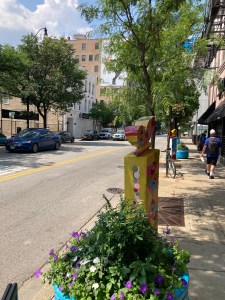
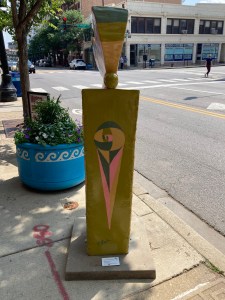
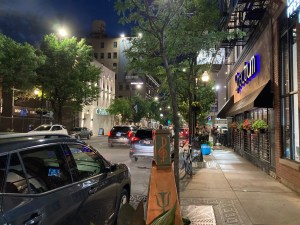
Halsted Street cityscape. Side view of sculpture with Psi, the Greek letter used to symbolize the famous Schroedinger Wave Function in physics
Poulos also saw fit to include hTz, the symbol for Hertz, the unit of measurement for frequency and sound. String theory operates under the presumption that these tiny strings create matter and light by means of varying frequencies, angles of integral, and whether the strings are open or looped close.
There are also glyphs of waves painted under the hTz symbol, reminiscent of the famous Schroedinger wave function, represented by the Greek letter Psi painted on the two sides of the sculpture. The wave function gives observational probabilities for the potential outcome of a quantum event. The copper color on the side runs downward, creating the appearance of waves of paint. More precisely, electromagnetic waves.
If you look really close, you’ll see the Greek letter Lambda which is used in physics to convey the Cosmological Constant, the rate of expansion of the universe alleged to be driven by dark matter, in addition to the symbol for the Planck Constant, which serves a dual purpose concerning the smallest possible emission of energy from light quanta, and is also used as a unit for the smallest possible distance in a spacial measurement.
Inside the museum’s Calamos Hall. The event was covered by ABC7 Chicago, among other media outlets
The ribbon-cutting ceremony was attended by a host of dignitaries, including Illinois Secretary of State Jesse White, Cook County Treasurer Maria Pappas, Water Reclamation District Commissioner Mariyana Spyropoulos, Township Committeman Dean Maragos, and Consul General of Greece in Chicago Emmanuel Koubarakis. Also appearing were Marianne Vallas Kountoures (museum executive director), Anthony Caputo (Chairman of the Greektown Special Service Area #16 which sponsors the art exhibits), President of Chicago Greektown Educational Foundation Irene Koumi, and business owner Eve Moran, an arts patron who serves as director of the Greektown arts project and whom has conceived of the various themes employed for the street art exhibitions.
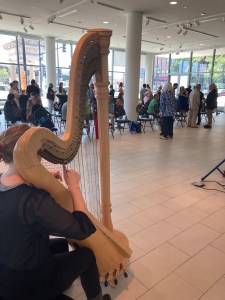
The presence of a live harp player added great atmosphere to the event. The harp is about the closest modern-day musical instrument to the ancient lyre
By Terry Poulos, Scientiquity founder and polymath artist
[CHICAGO, IL USA; 10/16/2021] Mother nature spinning geometry.
The mechanistic universe was how the ancient Greek atomists and astronomers viewed the world. This paradigm lasted all the way through Galileo and Newton – Mother Nature as a giant geared machine. Galileo looked to the heavens and witnessed the near-perfect regularity of planetary orbits. Newton thought time and space to be constant and fixed. It all seemed so predictable, machine-like.
Along came the 20th century advent of General Relativity, quantum mechanics and the uncertainty principle. Ever since, modern physicists have been attempting to debunk the mechanized universe theory (with a great deal of success, we should add). They view nature as a continuous, non-local phenomenon that does not always operate in terms of geared teeth (bits) or discreet media.
Furthermore, modern science also no longer fully accepts that the quantum realm holds any discernible cause and effect, opposed to the rotating gear moving an adjacent gear in clear temporal sequence, or Earth’s regular rotation and seasonal orbit about the Sun.
Non-locality and atemporal sequence are philosophical puzzles that vexed Einstein to his dying day. He explained gravity as the pull of the curvature of space, yet how did it act upon objects at a distance? Does gravity have its own “graviton” particle? Or energy wave? We still don’t have the answer. But Einstein held that all things could be explained in terms of logical cause and effect, even if our instruments were not sensitive enough to unmask and comprehend these supposed hidden variables.
All that said, even quantum physics admits a dual particle/wave nature of all known particles. The famous 1801 double-slit experiment by Thomas Young showed that light acts simultaneously as both a particle (photon) and energy wave, spreading out through a process called diffraction. And it’s not even a quantum experiment. It’s a classical mechanics set-up, something that can be replicated by a layperson in their own home, let alone a laboratory setting.
Recall also, Newton’s F=MA and Einstein’s e=mc² equations showing an equivalence between force, energy, mass, and acceleration. The mass, or bit, does exist. But where, and when? Somewhere in the spectrum of “reality” resides at least some modicum or fraction of a discreet “thing,” or bit. A 1927 experiment confirmed the same particle/wave principle for electrons. The current consensus is all particles have at least one part bit and one part momentum vector.
The atomists were not entirely wrong, nor were they entirely accurate. But we must admit the “thing” amidst the “things” does exist on some level, lest we entirely dismiss all notions of materialism.
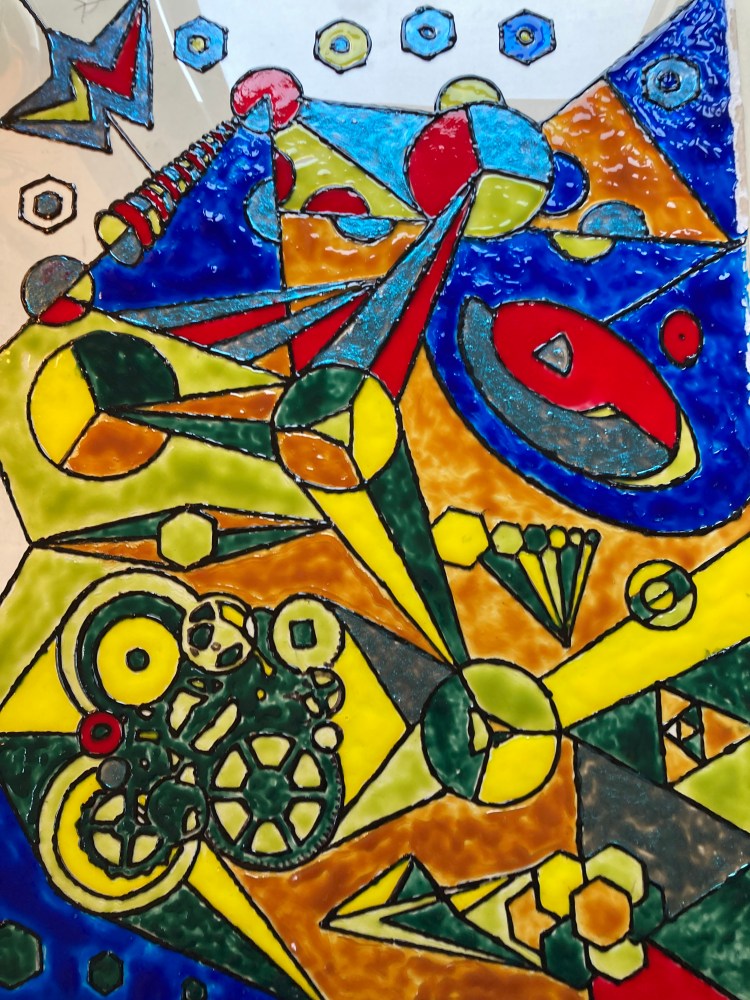
On the left-hand side appears a semi-abstract rendering of a feminine-looking being, eyes peering out albeit somewhat obfuscated. In the body position of what would be her womb is a geared mechanism. Her arms are turning the gears and spinning off geometric fractals. As the sequence progresses, higher complexity emerges.
The painting uses primarily gallery glass paint, with some glitter glue, applied on an acrylic surface. This allows a rear light source to penetrate through the acrylic. The dimensions are approximately the size of a standard wall poster.
The artist harbors hope that through art, we can fill in the blanks where equations and philosophy inevitably fall short. That we may further push the boundaries of knowledge and insight, and spark new ideas about nature and reality. And with a little luck, some day theoretical and applied scientists may run with said visualizations and take them in new directions heretofore unimagined, unrealized, and non-manifest.
Terry Poulos is a Chicago-area writer, archaeological historian, artist and geometer whose investigations focus primarily on physics, geometry and fractal topology, and Number Theory
[CHICAGO 9/20/2021]: Many artists produce what they call multi-dimensional art. Scientiquity created literally multi-dimensions of color and depth by employing a three-pane glass overlay featuring various geometric drawings, using light to tease out the colors, dimensions, and geometry.
The piece is titled “Tri-Mentional Fractal.” It’s the latest in a growing line of mathematical and scientific-related art – including sculpture, painting, numismatic, and hydro-refractive light art – by Scientiquity polymath artist Terry Poulos.
The final product is pictured top-left in the featured image. The top-right image is before color and other mediums were applied. The bottom image shows the three panes of glass individually.
Zooming in close, the viewer can witness a plethora of Rorschach-like fractal images – `shadows of shadows’ which ignite the imagination and spark inspiration.
YouTube video, animated version of “Tri-Dimensional Fractal”
The light, shadow, and color-induced illusions make for an extraordinarily unique, near natural blend of patinas that even the most experienced of artists might be hard-pressed to produce. Much of the effect is also attributed to texture and the use of colored mediums beyond solely paint.
For more information, contact the artist at Terry1email@aol.com.
Reverse side of “Tri-Mensional Fractal.” By turning the three panes of glass around, we get a different pattern and slightly different colors. The piece in essence is two paintings in one, and if we unfold the three panes, we get three individual paintings, as seen in the featured image at the top of this blog. That’s a grand total of five separate images, each distinct from the others Playing around some more with bits and pieces of the two sides of “Tri-Mentional Fractal” by Scientiquity
Terry Poulos is a Chicago-area writer, archaeological historian, artist and geometer whose investigations focus primarily on physics, geometry and fractal topology, and Number Theory
It has been said often that we live in a “post-truth” epoch. Allegations fly concerning fake news, false flags and false equivalences, half-truths, awful slants and spin, miss-direction, miss-information, or outright bold-faced lies. Partisan bickering and shameless pandering have left us in quite the sticky wicket and it’s downright fowl, to borrow a bird pun. There’s more information at our “smart”-phone fingertips today than at any time in history, yet is much of it a mountain of garbage?
Factions fight to stifle information. Even that old bugaboo of book banning has again reared its ugly head.
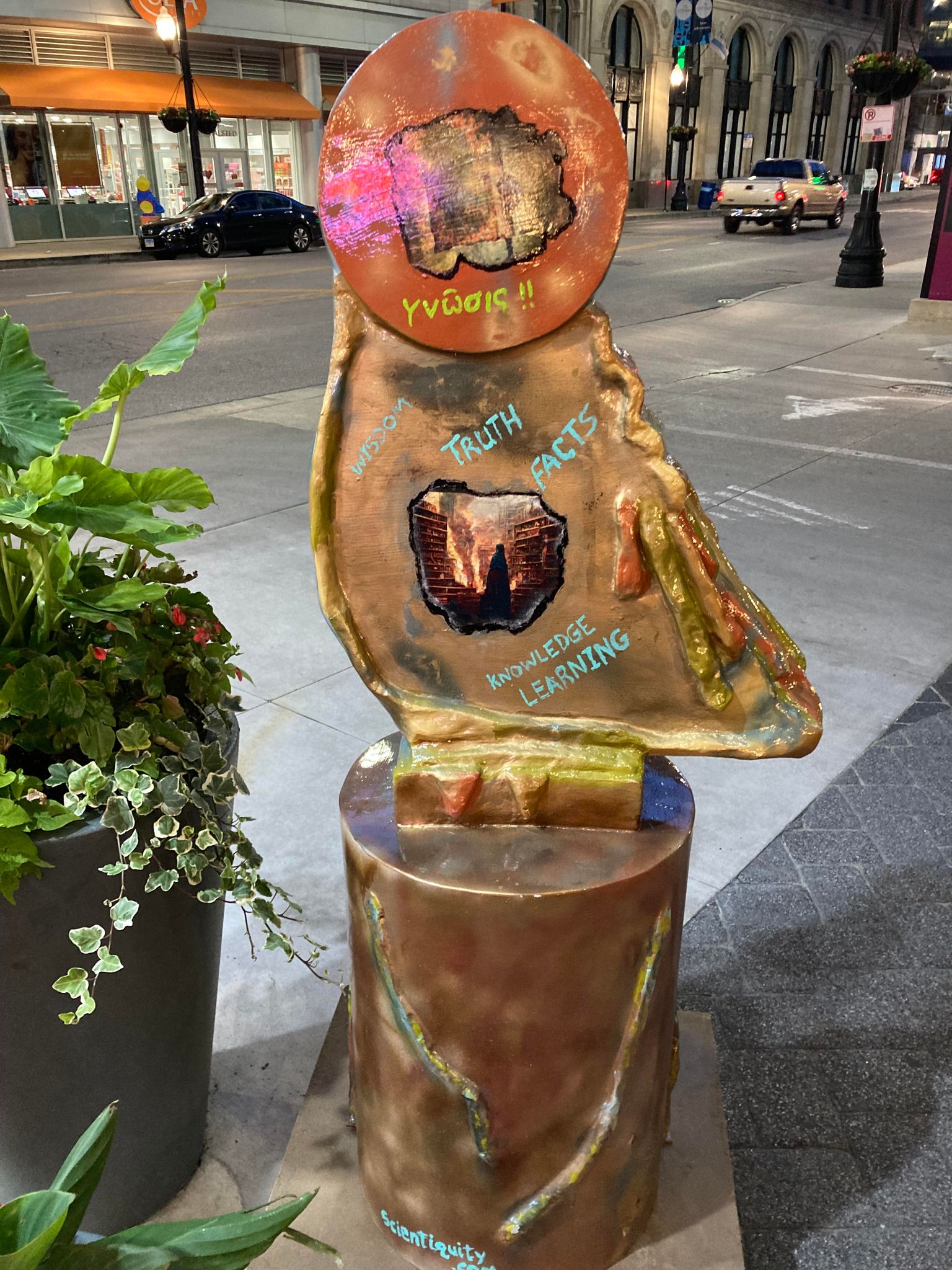
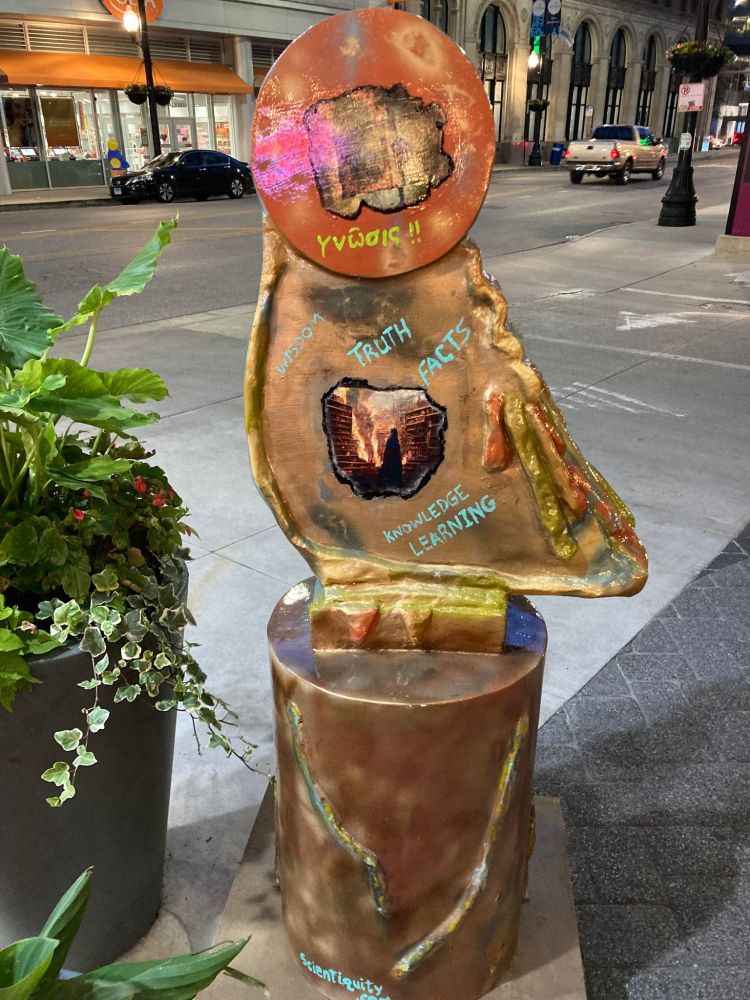
Enter Owlive, the “Bird of Trey.”
Owlive, the nocturnal owl, plays on the ancient theme of the Greek goddess Athena, who adopted the owl as a symbol of wisdom. The owl is ubiquitous in Hellenic culture and is also commemorated on the Greek Tetradrachma, a coin which once was widely-circulated legal tender.
The sculpture is part of a parliament of owls now lining Halsted Street in Greektown, Chicago, Illinois. The program, now in its 9th year, was commissioned by the Greektown SSA district and is headed by arts patron Eve Moran. Organizers aim to beautify city streets and inspire visitors and pedestrians, providing added incentive to patronage area restaurants and businesses. Close to 30 artists painted owls for this year’s exhibit. Scientiquity’s Terry Poulos was honored to be included in the exhibit for the 8th consecutive year.
Guardian of wisdom, truth and knowledge – Owlive projects her third (ergo, “Trey”) “mind’s eye” chakra via the mechanism of an owl’s 360-degree stereoscopic vision. To clarify, an owl generally is able to rotate its head 270-degrees but by doing so can access a 360-degree field of vision.
Our particular owl, Owlive, has some peculiar tricks up her collar. She’s able to amplify counter-intelligence through the mechanism of mind’s eye holographic projection and use it to combat vast disinformation campaigns, including against exponential AI (artificial intelligence) dark forces.
Owlive wears the tattooed scars of the burning of the Library of Alexandria on her back as a constant reminder of the vigilance necessary to defeat lies and untruths.
Birds of prey, as they call the owl, have witnessed catastrophic loss of knowledge and wisdom not only at Alexandria, but throughout history – through the Dark Ages, in false PR campaigns amidst the fog of two horrific 20th century wars, and beyond.
Owls have also been associated with omens at times. Today, our Owlive weeps after entering yet another ominous epoch of quantum uncertainty, moral relativism, artificial so-called intelligence, and the inhumanity of a deluge of propaganda. Owlive works to regain her once glorious hoot. However, her intellect is still intact. And she portends more omens.
Harboring fierce empathy, Owlive laments the new world order, personally feeling the physical and emotional daggers of her own foreboding premonitions. The sad, wounded owl is eager to sync with the parliament of other owls in hope that – collectively – birds of a feather may flock stronger together to douse the flames of discontent.
Owlive sets out on her nocturnal prOWL. She’s been the guardian of truth, wisdom and knowledge since time immemorial. She’s overcome the dark forces of disinformation and will again reprise her ascension to right the one, true universal Hall of Records.
Owlive greets visitors at the entrance to the Crown Plaza Hotel on Halsted Street in Greektown, Chicago. She booked the entire street-level suite through Spring of 2025, and holds court in front of the beautifully-refurbished Original Rye Deli & Drink restaurant 24 hours per day. Pay her a visit. She loves company and could use a hug.
Individual priority and credit in the age of AI: When the question IS the solution, our queries help AI learn and our IP gets scraped into the ethersphere
(NOTE: This article was published first on Medium minutes prior to appearing on Scientiquity.com
Objection, your honor. Leading the witness. It’s not solely a page out of a courtroom drama. It’s happening every time you ask a question of artificial intelligence (AI). You direct the machine toward the answer. This is the modern-day equivalent of the Riddle of the Sphinx.
In a way, to ask is to give. Careful what you ask for.
AI requires reams of data to scrape and subsume into its memory banks, in order for it to learn and improve. Evolve, so to speak. But will AI one day “kill” priority of creation and individual ownership of intellectual property? Notwithstanding patents. Does the individual still matter? Is the lone genius destined to have the fruit of their lifetime go unnoticed, unappreciated, unrewarded? Stolen away, repackaged and regifted?
I ask these questions because creators warrant recognition for their efforts. We all have egos and for many it’s what drives us to reach for greatness. But that’s just the half of it. Why should anyone put years of hard work into something, thousands of hours of research, experimentation and refinement, proprietary intuition and knowledge, with all the time and mental strain and vexing effort…only to see AI run with the output by instituting a slight tweak and spin on it, then giving it away to the next AI user who then usurps the original and authentic source?
And the cycle repeats ad infinitum.
Is this a product of singularity? The death of individual credit for the good of the collective?
If the next Einstein were to upload a complete Theory of Quantum Gravity (or Quantum Relativity), to the internet, replete with equations and fully-vetted philosophical and scientific formalism, would AI give credit where credit is due, even after AI churns through it and spits out an improved version? That is coming. Or the next user stumbles along and uses your queries and IP to take your theory to yet new heights.
Will the creative spark, the initial impetus for this world-changing paradigm, be recognized and rewarded? Or does it all get lost in the dustBIT of zeros and ones?
Granted, a community of humans — most notably the academic community — will be the ultimate arbiter of such a profound new paradigm. But the same way that computers are now “proofing” mathematics theorems and hypotheses, one would have to think AI will, in the end, play a substantial role in meting out the “last man (or bot) standing.” Incidentally, many mathematicians do not believe a computer proof is any proof at all.
In any event, is AI egalitarian? Does it have ethics? Can it acquire them? Does AI even possess the wherewithal to be the ultimate arbiter of truth?
We know AI has or will achieve critical mass. Eventually, large language models will feed on other large language models and intelligence will converge to a kind of singularity. The machine (collective world wide web) will become the overriding authority, and a hoard of facts and reality will absolutely be lost in the shuffle.
Priority and credit swept away in the dustBIT of history.
That said, should priority and assigning credit be the sole domain of humans? The folks at Cornell University maintain the not-for-profit global database ArXiv.org, the online e-print repository of all (quote) serious academic papers. However, you can’t get in the club if you’re not affiliated with a major institution. You must hold a Ph.D or Masters degree which is tethered to an established, recognized institution of higher learning. Otherwise, you can’t publish there (it’s a bit more complex, but that’s the general picture).
Of course, there’s a vast wasteland of papers and postulates and you have to draw the line somewhere, despite the fact Ph.D’s are not immune to publishing nonsensical waste product. Restrictions or no restrictions, ArXiv is not the end-all of facts, reality and priority.
Your other options, as a dilettante or novice, are to publish on Medium or some other portal and pray the platform lives in perpetuity, and is accessible to those who can effect change and assign priority.
Personally, I’m leaning toward a smart contract on the blockchain. It’s time-stamped and a permanent record, it’s verified across the seven-node network by mining (community consensus) or proof of work. The chain is strong and contrary to fear-mongering, as secure or more than traditional portals. It will become yet another “killer app” use case for academia and knowledge, as it has for currencies and now real estate, medical records, and so much more.
But can anyone find the paper efficiently, cite it and link to it? Today, only five-percent of the population in America is on the chain (note: That WILL change radically). Most importantly, can the scientific community find it?
The chain might be the solution for a future Michael Faraday. An apprentice with no formal education, the 19th century scientific prodigy is responsible for giving us the key insights into electromagnetic fields, which directly led to James Clerk Maxwell publishing the formal equations of EM, and that butterflied to Einstein developing Relativistic equations for the gravitational field.
In today’s physics, fields are everything. Faraday is a visionary who bulldozed the path for modern physics. He’s a giant of science worthy of mention with the likes of Maxwell, Niels Bohr, Albert Einstein, and Paul Durac.
Would Faraday get credit today, or be usurped by AI? He had to fight for his priority in the 19th century, and that was before the internet could — to paraphrase Mark Twain — “allow a lie to traverse the metaverse before the truth can get its boots on.”
There are two other potential outcomes. It’s also possible AI, in conjunction with a proof-of-work consensus blockchain, might make lying and deceit and misdirection and undermining of due priority less likely, or have a slightly indifferent influence.
Nonetheless, it is becoming a `Catch 22′ conundrum. Darned if you do ask AI questions, darned if you don’t. AI has gone mainstream and soon we won’t be able to compete unless we’re fully onboard. However, by doing so, we in part feed the beast. Teach the monster. Fuel the machine. Give it key clues!
We’re teaching AI new tricks. Human tricks. Biological creativity and uniqueness that AI can not yet itself produce. That could some day change. In the interim, AI is only as good as the input of us biological machines.
Questions — placed in context and in a certain sequence — can be as good as a solution. In the ethersphere, it’s `leading the witness” and there’s no judge to step in and play arbiter. AI may one day be the sole arbiter.
So be careful of what you ask AI. You may be giving away the store (advice: Protect yourself before going on AI to ask).
This all begs the question, will the give-and-take of AI eventually lead to the death of individual priority? Or will AI aid the greatness of individualism? Or a little of both. The truth is being written as fast as the speed of thought and brute force computation — ours and AI’s, respectively.
Is biology purely mechanistic? Mother nature (Ma) as machine churning the gears and cogs of life. Artwork above titled “Geo Ma-china,” the mechanistic universe (2021). Stained glass light art. Gallery glass paint on acrylic. Priority to artist Terry Poulos, creator of Scientiquity.com
Terry Poulos is a writer, artist, mathematics and physics autodidact, and fractal geometer whose inquests include a Theory of Everything, archaeology and ancient technology and science, and more
Collection by Scientiquity bridges Atlantis, Alexandria, Archimedes, Antikythera
Scientiquity 4A anthology
[CHICAGO, IL USA 09/04/2022] An extraordinary, imaginative new fusion of modern-ancient art was unveiled this weekend by Scientiquity, billed as “the science and art of antiquity.” The ensemble weaves together millennia upon millennia of science, technology, and mathematical knowledge in a collection of sculptures, paintings, hydro-refractive kinetic light art, and assorted mixed-media – titled the “4A anthología.”
The anthology includes 15 pieces: Three aquarium sculptures, three mechanism sculptures, one spiral vortex sculpture, one boat sculpture, one clock sculpture, two painting/sculpture hybrids, one stained glass painting, two outdoor sculptures, and one numismatic (coin). A total of 25 lights are employed to illuminate the water sculptures. Details on each individual piece are included in this blog.
Click image for 15-second YouTube video. Scientiquity moving light, water, and bubble show
The artist is also working on a new series of hyper-geometric paintings that will complement the 4A anthology and greatly expounding upon Plato’s theory of ideal Forms into the non-linear world of hyperbolic geometry.
Our narrative begins with the mythological lost, sunken continent of Atlantis (10,000 BC or earlier up to the time before the Egyptian dynastic era). Next we enter the reign of Alexander The Great, who founded the City of Alexandria and installed a Hellenic system of governance in Egypt. Near the end of the Hellenic dynasty, we encounter the genius Greek mathematician, inventor, and astronomer Archimedes of Syracuse (275-205 BCE), and ultimately find ourselves on the shores of the tiny Greek island of Antikythera, where the world’s first computer and most mysterious human-crafted object was found 50 meters beneath the sea in the year 1900 CE. The so-called Antikythera Mechanism (c. 205-160 BCE) was an astronomical calculator which continues to re-write history books on the capabilities and technology of the ancients.
Scientiquity founder and polymath artist Terry Poulos, based in Chicago, seeks to travel the collection to museums, galleries, and other institutions in America, Greece, Egypt and beyond. The goal is to share art and knowledge with others and at the same time create a film pilot under the Scientiquity brand. Content would include interviews with experts in archaeology, science, mathematics, and technology, combined with images and tours of famous archaeological sites, scientific and other educational and research institutions, and various genres of art – in a format that both educates and entertains.
With that in mind, Poulos is looking to feature other like-minded artists whose creations coincide with the philosophy of Scientiquity.
ART-ikythera: Modern-day rendition of the Antikythera Mechanism. World’s first sculpture of world’s oldest computer, an astronomical calculator. Exhibited at the National Hellenic Museum in 2016. Displays mechanism from a hybrid contemporary/ancient perspective, lending the observer a glimpse of its bronze glory when brand new, combined with the verdigris hue of bronze metal oxidation after 2000 years beneath the sea. Additionally, one padlock and key representing “ancient secrets and technology locked away for millennia.” Center-plate inscriptions: A for Antikythera, and constellation symbols for Ursula Major (the bear) and Taurus (the bull). Materials: Repurposed iron gears, brass center-plate, iron padlock, brass key, assorted brass accoutrements. Oil-based paint. Dimensions: 1.5′ length, 1′ width, 3″ depth. Weight 30 lbs.
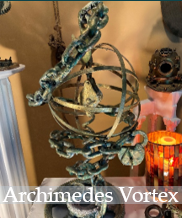
Archimedes Vortex, by Scientiquity
Archimedes Vortex: Honoring the inventions and mathematics of Archimedes of Syracuse (c. 287-212 BC), considered the greatest mathematician/scientist of ancient Greece. He’s perhaps best known for his famous quote “Eureka!,” which he yelled after discovering major principle concerning buoyancy and the mass (vs weight) of an object. The ancient genius is also noted for his seminal methods on calculating the value of the Pi constant, being the first to attain accuracy to the second decimal point of 3.14, in addition to his ground-breaking geometric work on circles, conic sections, and spheres (all part of the famous Archimedes Palimpsest), and an avalanche of inventions including the pulley, lever, burning mirrors and assorted other war machines. He’s also mentioned as the most-likely inventor of the Antikythera Mechanism. The vortex sculpture features a spiral chain winding its way around a pulley and 3D sphere, plus lock and key. Exhibited at the National Hellenic Museum in 2016. Materials: Repurposed iron chain and iron gear base, metal sphere, metal pulley, metal lock, brass key. Oil-based paint. Dimensions: 2 foot height, 1.5 foot width, 1.5 foot depth. Weight 40 lbs.
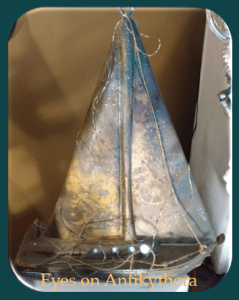
Eyes On Anikythera, by Scientiquity
EYES ON ANTIKYTHERA: Prefabricated hollow fiberglass boat painted by the artist. Part of the Greektown Chicago Outdoor Art exhibit “Karavákia” (2017). Piece is on loan from the Greektown SSA. On display every Christmas throughout Greektown Chicago. Painted verdigris green with bronze-colored gears. Honoring Captain Kontos and his brave crew who in 1900 CE stumbled across the shipwreck carrying the Antikythera Mechanism and a trove of bronze-age artifacts while diving for sponges. Dimensions: 1.5′ height, 1.5′ length, 4″ depth. Oil-based paint. Weight 20 lbs.
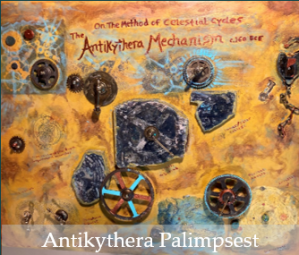
Antikythera Palimpsest, by Scientiquity
Antikythera Palimpsest: Hybrid painting/sculpture combining the Antikythera Mechanism in a joint narrative with the famous Archimedes Palimpsest, an ancient manuscript containing some of the most important mathematics of Archimedes of Syracuse. Embedded iron and brass gears and iron padlock, all repurposed items. Medium is a custom-made wood panel. Image transfer of the original mechanism’s fragments. Dials and pointers, brass compass, solar system configuration of the sun and five known planets of the era in a geocentric configuration displaying epicycles, the method of the era; Map of the island of Antikythera situated between the southern-most tip of mainland Greece and the northwest tip of the island of Crete; Two ancient coins c. 250 to 80 BCE which approximately coincide with the estimated dateline of the mechanism’s creation, the later years of Archimedes, and the period when the mechanism sunk in the sea while aboard a Roman-era vessel. Acrylic paint. Dimensions: 30″ length, 23.5″ height, 3″ depth
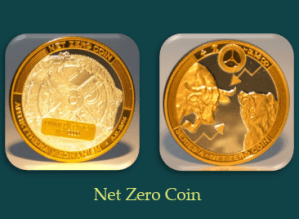
Net Zero Coin, by Scientiquity in conjunction with The Sports Index, Inc.
Net Zero Coin: Numismatic art commemorating the Antikythera Mechanism, the world’s first coin (2014 CE) to depict an image of the world’s oldest computer. Called “Net Zero” due to its canceling “implied denomination” of +Pi, -3.14 to infinity. Images of bull and bear representative of the stock market symbols for Bull Market/Bear Market. Proprietary rendering of the number zero with geometric trisection. Limited edition of 1000. Material: Copper base, silver bullion proof mirrored plating, 24k gold highlights. Dimensions: Approximates the Kennedy silver dollar. In the permanent collection of the National Hellenic Museum (NHM), British Museum, National Numismatic Association, and National Numismatic Society. Exhibited at the NHM in 2016
ATLANTIS LINE
Hydromeda Atlantis, by Scientiquity
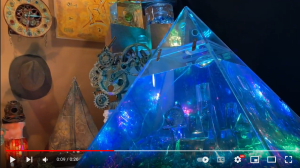
Hydromeda Atlantis: The centerpiece of the Atlantis line. Hydromeda derives from Hydro, Greek origin for water, and the galaxy named after the Greek goddess Andromeda. Indeed, the lighting in the container is reminiscent of galactic light scattering. Atlantis, meanwhile, derives from the legendary lost continent of Atlantis, made popular by Plato, quoting Salon, in his dialogues Timaeus and Critias. Plato tells of Salon’s travels to Egypt after Alexander The Great’s conquests, where Salon purportedly noted inscriptions on a temple wall that told of a long lost, sunken continent that may or may not have once possessed advanced technology and science. The Hydromeda Atlantis acrylic quadrahedron (four-sided pyramid with triangular faces and square base) stands three feet in height and approximates the dimensions of the missing capstone that once sat atop the Great Pyramid of Giza, the so-called Khufu pyramid. Plato and Archimedes were said to have studied mathematics at the base of the pyramid while living in Egypt during the time of Alexander’s installation of the Ptolemaic governance. The polygons employed in the Atlantis Line also inform of Plato’s ideal forms, of which the triangle, square, and hexagon are represented of the total of five forms. The aquarium container holds up to 70 gallons of water. The pyramid base is made of wood and within the base, the container is under-lit with 11 LED bulbs (6 kinetic), with one static light fixture inside the pyramid cap. The objects inside are all naturally-occurring forms made of glass which also resemble a sprawling metropolis. Hydromeda Atlantis has been exhibited at Art Aspen in Colorado (2019), as well as at SOFA Chicago (2019). It made its debut in a private ceremony held at the National Hellenic Museum. The triangular aquarium is one of three known pyramid aquariums in the world. It’s the first to be utilized as pure art, and the only quadrilateral pyramid aquarium which mirrors the Great Pyramid
Atlarctic Terminus, by Scientiquity
Atlarctic Terminus: The etymology of the title is a conjunction of Atlantis and Antarctica, and termination. A recent real-life academic study posits that after a great volcanic eruption (perhaps Mount Thera), the Atlantis land mass (or one large piece of it) broke away and over a period of thousands of years – at a glacial rate – literally floated to Antarctica and merged with the tundra, its final resting place, ergo terminus. To wit, numerous “out of place and time” tools and other implements have been found in the Antarctic in recent years after climate change has led to melting of some layers of ice. Atlarctic Terminus includes the green of the earth – notably an actual round sphere as in the Earth itself – along with the cold, white crystal-clear blue of the southern Atlantic Ocean. The forms, again, are also part of Plato’s ideals. Materials: Glass, wood base, five LED lights, water. Dimensions: Approximately 1′ height, 1.5′ depth, 2′ length, with 1-foot height base
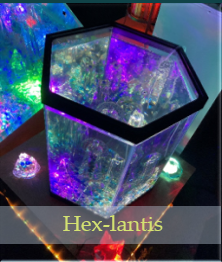
Hex-lantis, by Scientiquity
Hexlantis: Again, a play on one of the five Platonic solids, or ideal forms. We chose the six-sided hexagon for one of our three hydro-refractive light art sculptures. Inside are glass forms which appear to render the skyline of a city, or in this case a satellite of Atlantis, that being ancient Minoa. Materials: Acrylic container, glass pieces, water. Dimensions: Approximately 2.5′ height, 2′ width, 2′ length
Atlantean Continuum, by Scientiquity
Atlantean Continuum: Again drawing on the Atlantis myth of advanced technology, Atlantean Continuum is a time machine that allows the user to view the past, operating on principles of quantum physics and the theoretical Einstein-Rosen Bridge (a worm hole that can traverse the time-space continuum). This time machine rode aboard the piece of land-mass that broke away after the aforementioned volcanic eruption and floated to Antarctica. Hence, both the verdigris green of the oxidated metal and white tint hinting of ice. Materials: Repurposed iron gears, brass theodolite (instrument used to survey roads), brass ball clock, iron padlock and brass key. Oil-based paint. Dimensions: 2′ length, 2 feet height, 6″ width. Weight approximately 70 lbs.
Atlantean Harmonicom, by Scientiquity
Atlantean Harmonicom: Similarly, advanced Atlantean technology. Harmonicom derives from harmonic oscillator (operating on principles of Schumann resonance and a Lorenz attractor) and com, an abbreviation of communicator. The device would have allowed the user to listen in on the past. Materials: Repurposed iron gears and acoutrements, along with brass scale balance, brass celestial orrery, iron padlock and key. Oil-based paint. Dimensions: 2′ height, 1.5′ length, 1′ depth. Weight: 75 lbs.
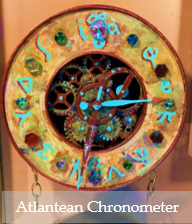
Atlantean Chronometer, by Scientiquity
Atlantean Chronometer: A clock from Atlantis that tells Atlantean time. Painted to appear with the look of an ancient manuscript. Opposed to numbers, this clock is adorned with Greek, scientific and mathematical symbols including infinity, alpha, zero, i (the imaginary unit), phi (1.61… the “Golden Ratio”), e (Euler’s constant 2.71…), Pi (3.14…), psi (also the symbol for Schroedinger’s Wave Function), upper and lower case lambda (lower case used as the symbol for the cosmological constant), ħ (symbol for Reduced Planck Constant), omega, sigma, delta (also main symbol in Maxwell’s equations for electromagnetism), and integral symbol. Materials: Plastic prefabricated clock, glass pebbles, glass hexagons, glass fractal beads, and glass pointer. Acrylic paint. Dimensions: 1′ height, 1′ length, 4″ depth. Weight: 10 lbs.
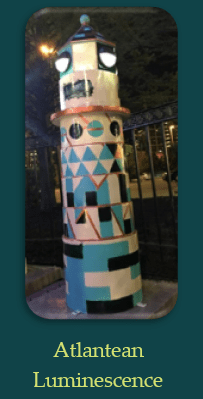
Atlantean Luminescence, by Scientiquity
Atlantean Luminescence: Part of Greektown Chicago outdoor art exhibit (2018). On display in Greektown 2022. Artist again commissioned to paint prefabricated hollow fiberglass resin sculpture for the “Re-Imagining Pharos” exhibit, honoring the now lost lighthouse at the port of Alexandria (named after Alexander). The Pharos Lighthouse is considered one of the seven wonders of the ancient world, as are the pyramids on the Giza plateau. Unique fractal design. Painted with acrylics, oil-based finish. Dimensions: 5′ height, 1.5′ width, 1.5′ depth. Weight: 50 lbs.
MORE HYPER FRACTAL GEOMETRY
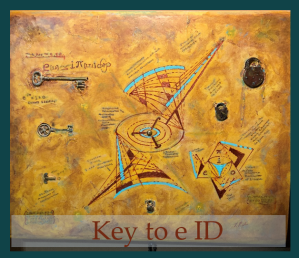
Key to e ID, by Scientiquity
Key to e ID: Meaning, the key to Euler’s Identity. Yet another hybrid painting/sculpture. The artist honors what is universally known as “The most beautiful equation in mathematics,” conceived by 18th century mathematician Leonhard Euler. The equation contains three of the most fundamental concepts in mathematics: e (Euler’s constant 2.71…), the imaginary unit i (or square root of a negative number), and the constant pi (3.14…). The painting not only renders new-age fractal geometry, it also portends a unique mathematical finding in the area of pure number theory which the artist will be publishing separately. Materials: Custom-made wood panel, embedded iron locks and brass keys. Acrylic paint. Dimensions: 30″ length, 23.5″ height, 3″ depth
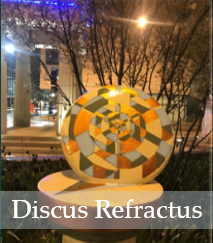
Discus Refratus, by Scientiquity
Discus Refractus: Prefabricated hollow fiberglass resin, painted by the artist. Part of the Greektown Chicago outdoor art exhibit (2019) celebrating the Olympic sport of the discus toss. On display in Greektown Chicago 2022. Rendering of unique fractal geometry. A different take on Plato’s Ideal Forms. Painted with acrylics. Oil-based finish. Dimensions: 4′ height, 1′ width, 1′ depth. Weight: 30 lbs.
Tri-dimensional Fractal, by Scientiquity
Tri-Dimensional Fractal: Hyperbolic geometric form using four panes of glass with staggered images overlapped to blend color and design using gallery glass paint. The stacked panes of glass give the piece literally multiple dimensions, and if one looks closely they can see paintings within the painting, a fractal recuctionist-type sequence. Furthermore, multiple perspectives can be achieved by changing the order and orientation of the glass panes. Materials: Wood frame, glass panes. Dimensions: 9″ square. Weight: 5 lbs.
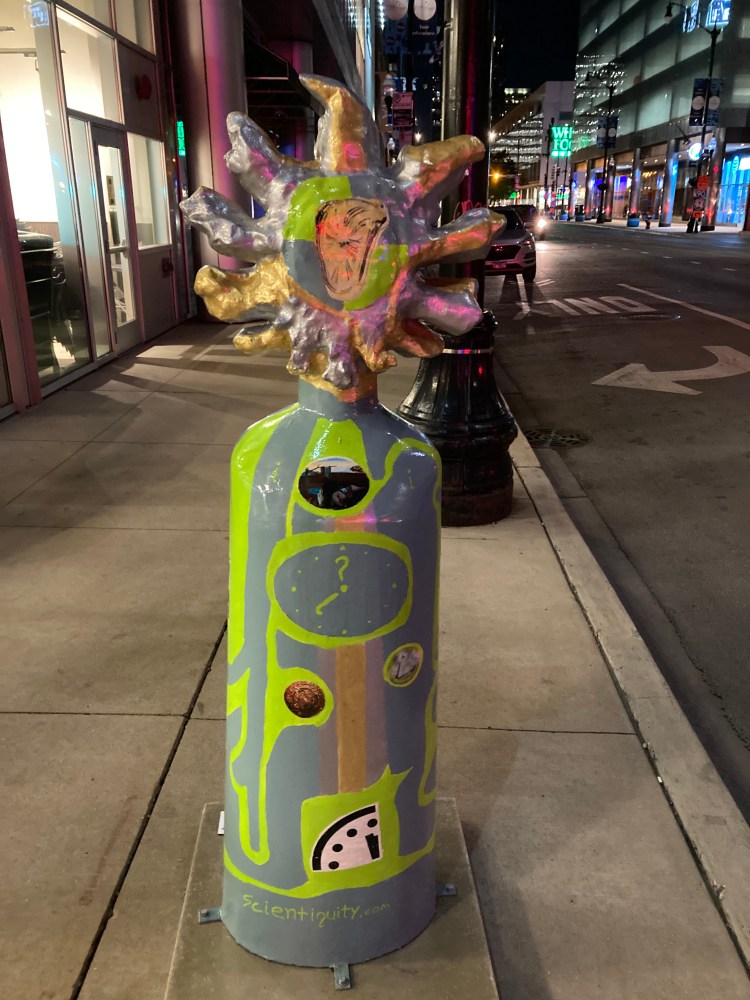
“Eye of Hours” by Scientiquity, on display in Greektown Chicago Summer/Fall 2021
By Terry Poulos, Scientiquity founder (originally published 6/15/2021)
The 2021 Greektown Education Foundation outdoor art exhibit “Hello Helios” hit Halsted Street in Chicago this June. Scientiquity polymath artist Terry Poulos, one of more than 15 artists selected, contributed a sculpture for the fourth consecutive year. The exhibition is designed to beautify the streets of Greektown Chicago, and provide thought-provoking works of art which brighten the daily commute for pedestrians.
“Eye of Hours” is the title of the Scientiquity piece and its main feature is a harmonic oscillating photon pendulum, exhibiting the concept of warped time at relativistic, luminal velocities. Images include the light spectrum, melting clock, solar eclipse, Salvatore Dali’s “Persistence of Memory,” sun dial, Tower of the Winds, Stonehenge, Aztec Sun Stone, Egyptian obelisk, ancient Egyptian solar deity Ra, Horus (as in “the Eye of Horus,” Archimedes’ “death ray,” an artist’s depiction of the ancient Helios statue (alternatively, the Colossus of Rhodes), and the famous “Doomsday Clock” from the Bulletin of the Atomic Scientists.
The artist’s intent is to depict time in all its various formations and means of computation beginning with the natural radiation of the sun’s daily 24-hour period of rise and fall, to the warping of time and space according to the principles of Einstein’s General Theory of Relativity, and human inventions and mechanisms, commemorative art and archaeological structures used to track time, and ultimately an ode to ancient myth and legend. The lights of Halsted Street at night doing their own photonic sculpting on Eye of Hours. Notice the red, pink, and purple tint from the night sheen, which lend a dynamic nature to the cascade of colors on the sculpture The famous “Doomsday Clock” from the Bulletin of the Atomic Scientists
Other side of “Eye of Hours” by Scientiquity
Eye of Hours is now on display, and can be viewed until Spring 2022, at the intersection of Halsted and Monroe streets in Greektown, Chicago at the main entrance of Mariano’s supermarket.
The Greektown Arts Committee coordinated the exhibit, headed by arts patron and Greektown business owner Eve Moran, who also designed the prototype for the sculptures.
Terry Poulos is a Chicago-area writer, archaeological historian, artist and geometer whose investigations focus primarily on physics, fractal topology, and Number Theory
By Terry Poulos, Scientiquity founder (Originally published 8/8/2020)
Scientiquity, a brand of science-based art billed as “The Science of Antiquity,” submitted a forth commission piece to the ongoing Greektown Education Foundation street art exhibit. The 2020 theme is Fun and Fanciful Fish.
The title of our piece is “Aquatic Decoherence.” It’s been given the nickname “Poly,” short for polyethylene terephthalate, the most common polymer used in single-use plastic bottles. These containers are a scourge in our oceans, seas, rivers, and lakes. literally choking marine mammals in record numbers.
For the fish’s eyes, we inserted the logo for Chicago-area marine conservation advocacy BlueRing.blue, a foundation established by Alex Rose, Science Editor and a principle writer for Ocean Geographic Magazine, and Managing Editor of Ocean Geographic Explorers.
The sculpture was installed this Summer and will reside at the intersection of Jackson and Halsted streets in Chicago’s historic Greektown, and will remain there for the near future.
Reverse side of “Aquatic Decoherence”
The United States has one of the developed world’s worst records when it comes to incentives for recycling plastics, and we’re also consumers of more products packaged in plastic than any nation per capita. Plastic in our waters was already reaching critical levels when Covid-19 hit in 2020. Since, it’s reached even more critical levels, with plastic in discarded masks also finding its way into the waterways, and eventually into our food supply and the air we breath.
It takes at least 450 years for a plastic bottle to completely degrade
Globally, more than a million plastic bottles are sold every single minute
In the U.S., only 30% of these bottles are recycled; Norway recycles 97%
Bottled water requires up to 2,000 times the energy used to produce tap water
Between 1994 and 2017, water sales in the United States had grown by 284 percent, according to Beverage Marketing Corp. data published by the Wall Street Journal
Today, plastic bottles and jars represent about 75% of all plastic containers, by weight, in the United States, according to the Plastics Industry Association
ABC15 report, more than 1.5 BILLION masks believed to have entered oceans in 2020
Scientific American report, Covid-19 has worsened the ocean plastic pollution problem
CBS News report, microplastics in drinking water, WHO study
MARINE LIFE
2020 New Scientist report, most whales and sea turtles seem to have plastic in their bodies
2019 National Geographic report, whale dies with 88 pounds of plastic in its stomach, comprising 8% of its total body mass
Water comprises on average between 65-80% of all fish body mass
WATER IN GENERAL
Sources: Encyclopedia Brittanica, Wikipedia
Water covers 71% of the Earth’s surface, mostly in seas and oceans
Groundwater accounts for 1.7%, glaciers and ice caps of Antarctica and Greenland another 1.7%
Air contains water vapor and clouds formed of ice and liquid water result in precipitation in the amount of 0.001% of the total
Water is the main constituent of Earth’s hydrosphere and the fluids of most living organisms. It is vital for all known forms of life
Water’s chemical formula is H2O, one atom of oxygen and two atoms of hydrogen
Water is connected by covalent bonds which decohere under the stress of outside chemical elements
IN THE AIR
A 2020 report in Science Direct cited the world’s first incidence of microplastics found in a human placenta
2020 New Scientist report, microplastic pollution discovered near top of Mount Everest
Cosmos magazine report, microplastics problem “worse than we thought”
Scientific American report, thousands of tons of microplastics are falling from the sky
Aquatic Decoherence stands approximately 4 feet in height and is about 3 feet wide. Other items found on the surface include one empty plastic bottle inserted on the mouth of the fish, the image of plastic bottles floating in water, and the message “Save our waters.”
Terry Poulos is a Chicago-area writer, archaeological historian, artist and geometer whose investigations focus primarily on physics, fractal topology, and Number Theory

























 Scientiquity
You must be logged in to post a comment.