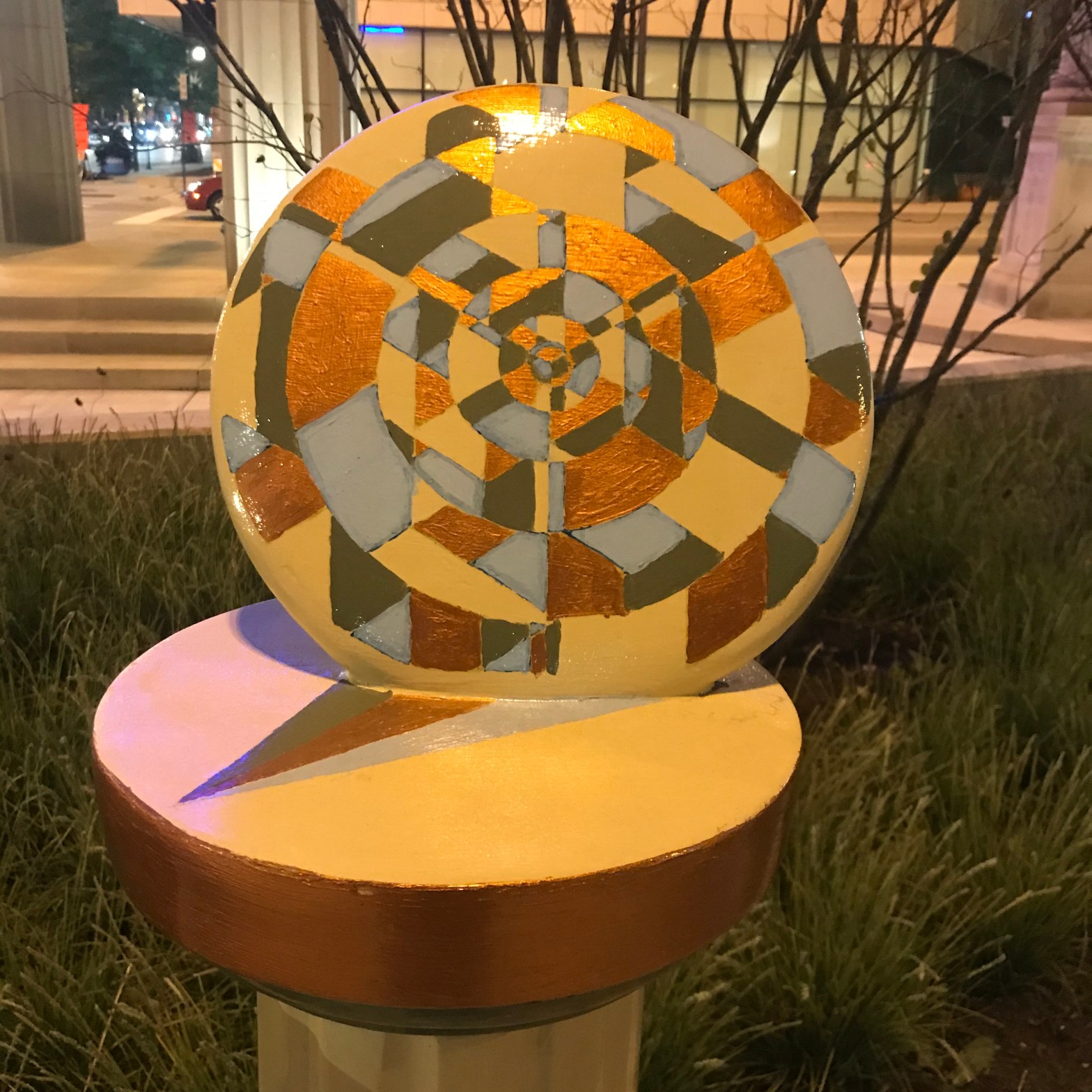
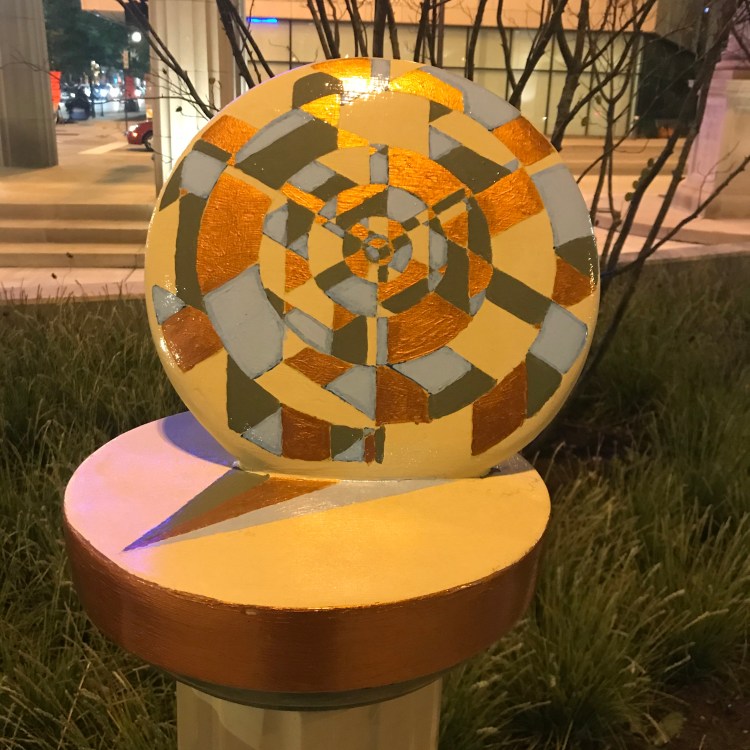
[CHICAGO, IL USA] The Scientiquity sculpture “Discuss Refractus,” along with about 20 other sculptures by various artists, in May was moved to a site adjacent to the National Hellenic Museum in Chicago.
The sculptures will take up residence at the intersection of Halsted and Van Buren streets for the foreseeable future.
The outdoor art exhibit is an initiative of the City of Chicago to beautify neighborhoods and inspire people in their daily commute. The West Side Chicago Greektown neighborhood program was spearheaded by business owner Eve Moran, who worked with the Greektown Arts Committee (GAC) and Special Service Area #16 to conceive and fund the project. Moran chairs the GAC committee.
“The Modernity of the Ancient Greek Discus” is the theme of the 2019 exhibit. This is the fourth consecutive year of the program. Past exhibits include “Re-Imagining Pharos” (2018), honoring the Lighthouse at Alexandria, one of the seven wonders of the ancient world. Scientiquity’s entry was “Atlantean Luminescence,” placed in front of Athena Restaurant. In 2017, the theme was “Karavakia,” an homage to the Greek sailboat. Scientiquity contributed “Eyes on Antikythera” for that exhibition, placed in the window of Athenian Candle Company. In 2016, the theme was assorted poster art and Scientiquity’s “ART-ikythera” sculpture and “Net Zero Coin” were featured on one of the posters, again placed at Athenian Candle. Artists, including Scientiquity’s Terry Poulos, are currently at work on the 2020 exhibit (TBA soon).
“Discuss Refractus” represents fractal art, a math-based concept incorporating a geometric expansion series. It is meant to convey surface projection of order amidst chaos, although upon closer examination one can discern emergent, obfuscated patterns. Previous to moving to the new site, Discus Refractus was located for the past year near Greek Islands restaurant at the corner of Halsted and Adams streets.
Terry Poulos is a Chicago-area writer, archaeological historian, artist and geometer whose investigations focus primarily on physics, fractal topology, and Number Theory
“Concealed and Revealed” by artist Euripedes “Rip” Kastaris of St. Louis, MO
By Terry Poulos, Scientiquity founder (originally published 11/22/2019)
Last week we addressed how visual ‘art’ was the alpha of human evolution, with gestures preceding the spoken word as the primary mode of communication. In this way, ‘art’ was the initial driver of complexity of intelligence. Throughout time, visual art and science have been complementary, feeding off one another and co-mutating.
A common refrain among academics is that Euclid’s “Elements” is the most successful, influential textbook ever written. Its compilation of fundamental axioms of pure Number Theory and linear geometry are still taught in nearly every elementary school classroom across the entire developed world, nearly unedited. Elements was the alpha of advanced mathematics. It has been estimated that after the Bible, Elements is the second most distributed literature in the history of publishing. That’s one influential book! And its geometry has informed nearly every artist from Classical times through the present. It’s math has also informed the sciences quite well, all the way through modern quantum particle models. “Elements” as geom-ART-ry
But is Elements one of the most `beautiful’ and ‘influential‘ works of art ever created? Answering a question with a question, is geometry not art? Equally as relevant, is art not geometry? Science owes much to the visual arts, and art owes much to science. Each serves the other.
“If every true art is always contemporary and every contemporary art has its origins in antiquity and every artist becomes a scientist and a scientist an artist, therefore art is a real proof of infinity,” opined artist Gosia Koscielak Krolikowska, also atelier at Gosia Koscielak Studio & Gallery in Wilmette, Illinois. “Digital Creek” by Gosia Koscielak. Digital projective art
“Digital Creek” by artist Gosia Koscielak Krolikowska of Wilmette, IL
Disclaimer: Scientiquity (“the art and science of antiquity”) is grossly biased on this topic. But that alone doesn’t impair proper perspective. Art serving science is backed by more than a few artists, mathematicians and scientists. But Euclid alongside Rembrandt? Granted, that’s a tough sell. Personally, I’ve got Euclid miles ahead of the oft cartoonish Matisse, but that’s just me.
What we can state with certainty is that the teachings of Elements were highly influential with the majority of artists throughout history, most notable being Leonardo da Vinci and M.C. Escher. Elements informs of perception, dimension, composition and structure. Whether it be realism, impressionism, geometric or most any genre of art, only the most radically abstract artist gets a pass from Euclid’s classroom.
As for beauty, that depends on how one defines art. If by art we mean visual representation of any kind – whether it be a Picasso sculpture or Pollack fractals, or the Golden Ratio in architecture – then Euclid is indeed in the pantheon of all those who’ve painted nature’s truths. We could go on but in the end it’s perhaps a matter of semantics, our choice of nomenclature. You say geometry, I say geom-ART-ry. In any event, we know for sure art has benefited greatly by science and mathematics.
“The Camera Obscura was an invention that changed art forever,” notes Euripedes “Rip” Kastaris, a St. Louis-based painter/sculptor who works with traditional and digital media and has been an official poster artist for the International Olympic Committee. He’s also been commissioned to paint major public works projects. “Camera Obscura was a projection device with a lens that Vermeer used to produce art that was more photo realistic than anything previously. The lens can be focused to project an image onto the back of a canvas. Artists could then trace the image. It was a genuine game-changer that would forever make art look more realistic than it ever had. Camera Obscura would shift art we recognize as Byzantine or Medieval to what we now see as realistic.”
The myriad color pigments used in art were fused by alchemists (forerunners of scientists) throughout the ages, and later built upon by modern scientists. One particular innovation that forever altered the course of art is oil-based paint, a paradigm shift for its slow drying property and the ability to blend color and glaze.
“Oil paint can create more subtlety and you’re much better able to glaze using a small amount of pigment diluted in medium,” continued Kastaris. “Glazes can be put on, layer after layer, so rich pearlescent finishes can be achieved.
“Michelangelo’s works in the Sistine Chapel were cleaned and a lot of people believe it was cleaned too thoroughly,” added Kastaris. “The theory was he intentionally over-intensified his colors so they were too bright, cartoon almost, and then he would finish the painting by putting a glaze of dark smokey color, rubbed over it and selectively removed, to adjust the final vibrancy of the work. Some scholars say that they cleaned the grime off but mistakenly took the layer of glaze off as well, revealing the currently over-intensified results that were not the final intent of the artist.”
The grand-masters all had one quality in common; maniacal devotion to detail. Leonardo spent the last 14 years of his life painting the Mona Lisa and didn’t even finish! This was common for Leonardo, who was never satisfied with any of his art. It’s what made him who he was, the greatest hybrid painter/inventor/scientist/mathematician in history. He studied the science of optics and light to an extreme, dissecting upwards of 200 or more cadavers to examine up-close the intricate bone, muscle, tendon, orbital and vascular structure of human and animal anatomy.
Many go so far as to assert that Mona Lisa’s eyes follow you as you go from side-to-side, a credit to Leonardo’s master craftsmanship and scientific obsession. Kastaris clarified the latter notion.
“If the eyes in a painting are looking straight out at the viewer,” Kastaris insisted, “they will follow the viewer wherever they go. It’s a universal phenomenon of any painting. If you move, you will perceive this as the eyes following you, but it’s an optical illusion and has little to do with da Vinci having some special quality about his approach, although his skills may have enhanced the effect.”
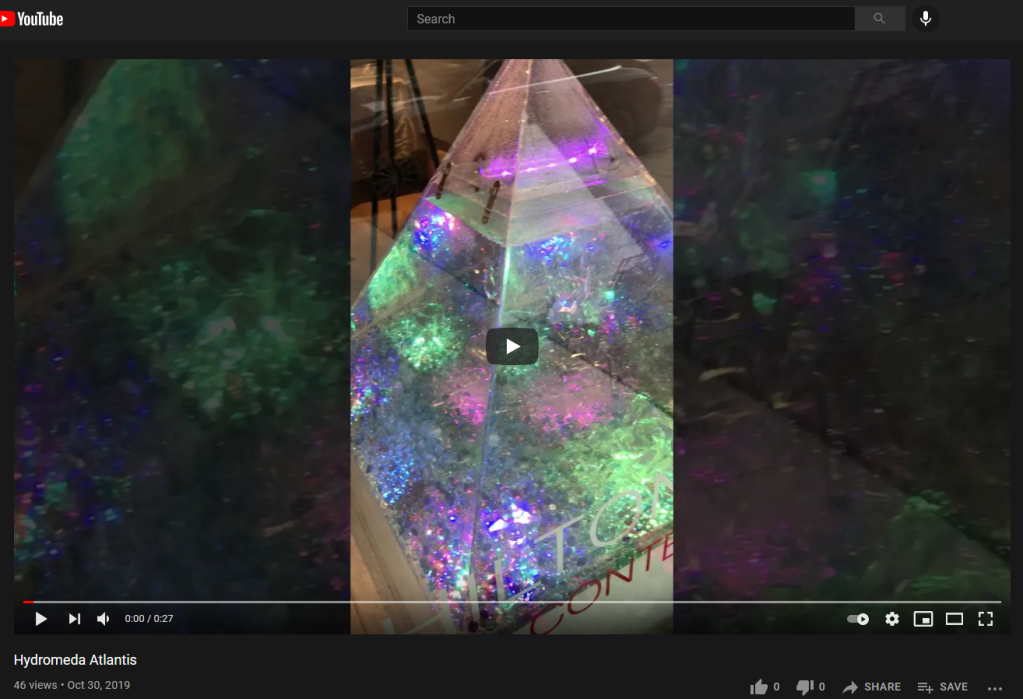
While da Vinci revolutionized the Renaissance approach with his “smufato” blurred edges, which captured the essence of the real world, in modern times LED technology (Light Emitting Diodes) has been further evolving art. LED bulbs don’t heat up like traditional bulbs and last far longer, up to five years or more. It enabled Scientiquity to create “Hydromeda Atlantis,” a world-first new genre of art called “Hydro-Refractive Kinetic Light Sculpture.” Video is another on the current cutting edge.
“Today anyone can, for a small investment in gimbal stabilizers, mirrorless cameras and high quality lenses, make movies that look as good as what was done in Hollywood in the golden age of cinema,” related Kastaris. “The tech has given artists a chance to make moving pictures for the same price as painting a canvas. Add an aerial drone to that recording set up and you can do magic. You can currently buy a high end drone with a 4k camera for about $1000 that’s better than broadcast quality and has four times the resolution as standard hi-definition.” And so it is that art and science come full circle, cycling back and forth in an eternal feedback/feed-forward periodic pattern, scaling off one another and co-mutating, pushing each to greater heights of complexity and inching us toward that fractional geometric series called “infinity in the limit.”
Terry Poulos is a Chicago-area writer, archaeological historian, artist and geometer whose investigations focus primarily on physics, fractal topology, and Number Theory
(Editor’s note: This blog was first posted on October 14, 2019)
Sometimes, history only survives out of sheer luck. For instance, the ancient Antikythera Mechanism, most cited as the world’s oldest computer and almost universally thought to be the world’s most mysterious human-crafted, extant ancient artifact. This marvel of Greek invention sank in a ship in or around 50-60 BCE and wasn’t seen again until a small crew of daring Greek sponge divers stumbled across the wreck in 1900 CE. Two millennia had passed!
The ship, a Roman-era vessel, by the hands of fate or random fortune, managed to settle on a 50-meter deep shelf off the coast of the Greek island of Antikythera, located due north of the island of Crete and due south of mainland Greece. The shelf was precariously perched a few short meters from an abyss. Had winds from an ancient storm carried it any farther, it would have been lost for all eternity. We’d still be in the dark about the true capabilities of the ancients. But it was not lost. Ergo, the history books must eventually be re-written.
This month, divers returned to the shipwreck to re-survey the site and excavate a few select items. It already qualifies as one of the richest hauls of Bronze-age artifacts ever discovered in a shipwreck. The late, great marine historian and filmmaker Jacques Cousteau documented the wreck in the 1950’s and again in the 1970’s. The mechanism itself has been the subject of numerous books as well as a BBC film documentary.
Scientiquity was the first to commemorate it in sculpture and on a numismatic, called “Net Zero Coin” (NZC). Our ART-ikythera sculpture was exhibited at the National Hellenic Museum (NHM) in 2016, as was NZC, now in the permanent collection of the NHM, the British Museum, the American Numismatic Society, and theAmerican Numismatic Association. As you might gather, Scientiquity is near-obsessed with all-things-Antikythera!
“ART-ikythera” by Scientiquity, modern-day rendition of the ancient Antikythera Mechanism
The functions of the mechanism have been definitively confirmed by mathematicians, astronomers, technicians, archaeologists and other experts. It had a minimum of 40 gears and served as an astronomical calculator which could predict solar and lunar eclipses (and more) decades in advance, and track the motions of the five planets known to the era, in addition to tracking galactic constellations.
The device was estimated to have been built around 160 BCE, although evidence exists indicating its invention may have preceded that by another 100 years or more. The legendary Archimedes of Syracuse, considered the greatest scientist/polymath inventor of antiquity, is most speculated to have been its inventor, albeit whoever made it worked in conjunction with a workshop of other astronomers, mathematicians, metallurgists and artisans.
“Net Zero Coin” by Terry Poulos (Scientiquity), the world’s first coin commemorating the Antikythera Mechanism. The numismatic is in the permanent collection of four museums: British Museum, National Hellenic Museum, American Numismatic Association, American Numismatic Society
You protest: But Terry, they didn’t even have indoor plumbing at the time. True. They did not – in 160 BC. However, there absolutely were fresh and waste water pipe systems in ancient Minoa (c. 2500-1500 BCE) at the city of Knossos that was buried in ash and preserved similar to Pompei. Knossos is now modern-day Crete, coincidentally a stone’s throw away from Anikythera.
Innovation and knowledge ebb and flow. For proof, all we need do is cite the 1500 years after the Antikythera Mechanism where technology regressed. There is no linear trajectory of advancement. It’s apparent that we go two steps forward, one step back, then forward again. The modern equivalent in complexity to the Antikythera Mechanism didn’t arrive until the Renaissance with the arrival of European clockwork.
The Antikythera Mechanism is an outlier, a unicorn. Something that quite simply should not be. And yet, there it is, residing today at the National Archaeological Museum in Athens. Perhaps we’ll find more of these ancient marvels. Hopefully we won’t have to wait another 2000 years.
Terry Poulos is a Chicago-area writer, archaeological historian, artist and geometer whose investigations focus primarily on physics, fractal topology, and Number Theory
By Terry Poulos, Scientiquity founder (originally published April 14, 2020)
A species-wide existential threat is corrupting human bio-coherence, breaking down human cells. Said to be “on the edge of life,” the Covid-19 Coronavirus mutated to the point that this “giant virus” is now homing in on autonomous information capacity. Unlike bacteria, viruses are aerosol and can travel via air particulate directly into our respiratory system.
At what stage is the human species at in terms of collective cooperation to fight this invisible enemy? Trapped in a quagmire of fake news oblivion! Naturally, it came to a head right around April Fool’s Day.
Fake news has been around forever but recently went supernova. We have politicians who make fake news centerpieces of their campaign strategies. Now Coronavirus has taken it to a whole new level of grandiose conspiracy theories, many alleging the virus is an epic false flag. Or that it’s a lab-engineered bioweapon, despite almost all scientificevidence to the contrary. In this “post-truth era,” Coronavirus – while itself very real – has nonetheless become the gold standard of conspiracy theories, the Shangri la of grassy knolls.
Humans have practiced deceit since our origin. The arbiters of “truthiness” swore that Galileo and Copernicus were fake news. Shamans, alchemists, soothsayers, and fake medicine men have all plied their shady wares, and many a religious huckster has wormed their way into our confidence. Indeed, fake news is by no means privy to politicians and authority.
In modern times we’ve encountered countless snake-oil salesmen and slithery corporations. Technology has wrought “spoofed” social media profiles, emails and websites. We’ve witnessed forged signatures, counterfeit money, and cheap knockoffs among myriad hoaxes, frauds, and fictions. Photoshop and “deep fake” videos are so authentic as to be nearly indistinguishable from the genuine articles. The phonies are legion!
It begs the question: Are chaos and veiled reality encoded in the substrate of all things? A theory that has steadily been gaining evidence is that the universe is one giant virtual-reality simulation. Perhaps culture merely reflects this veiled nested reality within ever-more veiled nested realities. Fake news may be embedded in the universal DNA/RNA. Is fake news embedded in the universal DNA?
You counter, “I can see and feel the universe. Stop your fake news!” Be gentile, gentile reader, for the following might just yet have you “seeing” reality in a whole new way – real and fake.
What we see with our eyes is a final rendering of a process that scales up through a trillion-trillion neuronal interactions. Stimulus enters the optical and tactile senses and is routed through the spinal chord near simultaneous with the brain. A “snapshot” is forged and spit out into our mind’s eye, an “end-state” product that lags the event. Study after study confirm that when we do take action to, for example, move an arm, the decision to do so was initiated fractions of a second prior to the physical motion of the arm moving. Consciousness is late to our own party. It’s reactionary.
Everything is filtered and veiled by sensory organs. We see via light. Light is an electromagnetic interaction. When an electron is jostled, it emits a photon, the particle part of the particle-wave known as light. This particle is often detected in two places at once and its position and velocity cannot both be measured simultaneously due to quantum uncertainty.
Special Relativity, for its part, says you’ve got your version and I’ve got mine. But even within you there are trillions of potential action potentials. Your mind’s eye captures but one in an instant. The lone survivor, or quantum “collapse of the wave function.”
On large scales, the universe is estimated to have a visible horizon of 92 billion light years across, the distance light traveled in the 13.8 billion years since the Big Bang. That’s just the space our instruments are powerful and sensitive enough to detect. Space might be potentially infinite.
Within space is a small amount of “stuff” including known matter such as stars and planets, which comprise five-percent. Another 25-percent is dark matter and 70-percent dark energy. The dark components are not directly visible to our instruments, but scientists know they exist based upon gravitational influence. They do have sway. It’s not fake but it’s not “all there” either.
Compared with the vast gap between Earth and the Sun, not to mention far larger gaps between galaxies, the mass we do see is a minuscule blip. Science also says the universe has an aggregate of zero energy. By the law of conservation, what is “lent” to matter must be returned to the vacuum. Everything is temporary!
Condensed matter, in this perspective, is a group of temporary atoms, in sync, which combine to form molecules. Hydrogen is the simplest, lightest and most abundant element in the universe, comprising 90-percent of that five-percent. Hydrogen atoms have one proton and one electron. A proton is primarily three quarks, although other atoms have neutrons but since neutrons have zero charge, they’re nearly insignificant. Bosons and neutrinos are virtual particles that interact with quarks, but they’re believed to have zero or near-zero mass and barely interact.
These constituent particles have fleetingly fast life-cycles, often measured in Planck units, the smallest theorized quantum bit of time and space. Meanwhile, hydrogen has charges that cancel exactly to zero. Think about it: The stuff that props up 90-percent of all known matter has zero charge, must return its energy, and can barely be said to have existed time-wise. Dare say, fake? Hydrogen is 90-percent of all standard matter, has zero charge, must return its energy, and can barely be said to exist time-wise. Dare say, fake?
Furthermore, no quark has ever been isolated. The only time a quark is “seen” is when it has two companion quarks. Adding to the fakiness, the human body reconstitutes 98-percent of its atoms every single year. By the time you turn two years old, you will have not a single atom in your body from the time you exited the womb.
Granted, a body’s geometry, the quote “physical” volume, continues regardless. But 99.999…-percent is energy potential only. Religion has a name for this: spirit. The creator or creation force works in ethereal ways indeed.
Lastly and strikingly on-point, the distance from a proton to an electron is so vast a ratio that if measured in cosmological terms, it would be on the order of that between Earth and the next galaxy, or farther. So not only is the large scale universe virtually empty, the small scale universe also is vastly separated. That’s a whole lotta nothin’!
In summation, the overwhelming majority of “stuff” exists on scales so far apart in space and for so small a duration in time that it’s plausible the universe is the ultimate virtual reality machine – both fake and only temporarily real. This logic is derived from Standard Model physics. Let me guess, fake news.
The hurdle we face is to distinguish real from fake. With far too many anti-science attitudes and adherents of fake news, how can we ever combat Coronavirus, let alone solve the mysteries of the universe?
Terry Poulos is a Chicago-area writer, archaeological historian, artist and geometer whose investigations focus primarily on physics, fractal topology, and Number Theory
(Editor’s note: This blog was originally published on October 22, 2019)
What’s the true color of the universe? Einstein would say it’s all relative. Our eyes deceive us. They’re receptors of the full spectrum of electromagnetic waves which produce an emergent perception of color and images. The seat of those images is our “mind’s eye.” Color and all visual images in our mind’s eye are a construct. Repeat: Color is constructed, not an inherent property of the universe. But there is a species-wide consensus. We’ll get to that shortly.
Artists, myself no exception, are naturally fascinated by color. We mix and match and experiment with a myriad of varying pigments to produce arrays of images designed to inspire and provoke visceral thought and emotion. But what do we really see in color when we claim that the dress is blue (a recent viral internet phenomenon), a person has green eyes, or that blood is red? Red, blue, and green to whom? More to our point, to what?
The scientific definition is that light for human perception, and thus color, is a manifestation of the visible spectrum of electromagnetic waves, which is a range of wavelengths between infrared and ultraviolet light. You’ve probably heard of a few others in the spectrum which we cannot perceive without the assistance of mechanical instruments – microwave, x-ray, shortwave, ultraviolet, gamma, and infrared are a few examples. Human eyes only perceive those between ultraviolet and infrared (400-700 nanometers in length).
Humans, ever since our origin in antiquity, have evolved concurrently with the field of existence. We’re in the universe – part of it – ergo as Depak Chopra and Menas Kafatos wrote in their recent best-seller, “You are the Universe.” This is not simply a manner of speaking, it’s scientific fact. Nothing within any system is ever divorced from or independent of that system. With that knowledge, we’re forced to concede our ignorance of the overwhelming majority of reality. Why? Because we can never view it from outside the system. There is no privileged vantage point!
Knowing this, how do we trust red is red, blue is blue, and green is green (the three primary colors; all else are gradients)? It is true the human species has evolved a common consensus on the various colors, albeit we all see colors in ever-so-slightly different ways. There’s that pesky relativity again. We see a potentially infinite gradient of electromagnetic waves. My sincere apologies if that’s not romantic in the tradition of the Renaissance masters, but that is exactly the way the universe operates.
To underscore that last point, a neurological examination of the genders revealed a significant percentage of women see up to one-thousand times more color gradients than the average man, owing to their having a more evolved system of optical rods and cones and functions having more degrees of freedom. No wonder husbands worldwide are pathetically dependent on their wives to mix and match outfits! Levity aside, you’d think with their enhanced visual prowess women would be the foremost artists globally. But alas, that is a historically male-dominated field with one-hundred Claude Monet’s for every Georgia O’Keeffe. We can chalk up most of that unjust imbalance to male chauvinism. But, as the modern saying goes, “time’s up.” Change is upon us, to be sure. And according to science, rightfully so.
Back to the original question! What’s the color of the universe? Two studies on the color of the universe and the color of our solar system shed new `light’ on the subject. In the early 2000’s, scientists proclaimed that the universe is turquoise, which excited me personally because I love a good patina! According to “Big Bang” cosmology, the universe is 13.8 billion years old, an awful lot of time to develop a rich blue-green color. But along came a more advanced study showing the universe is generally a beige hue, which is still good because I love the yellow-ish color of ancient manuscripts! As for our solar system, science is saying green again. Apparently, the life-giving force for humans, oxygen, carries with it one of the primary colors. So maybe the universe isn’t quite a patina but our part of it, the Milky Way and specifically our solar system, is exhibiting green and beige. Close enough for this fan of the science of antiquity (Scientiquity)!
In any event, we must be honest about our ignorance. Color is relative to human perception mechanisms, and even intra-species it’s relative from one person to the next. Who’s the grand arbiter? Where’s this great da Vinci or O’Keeffe in the sky to decree the substrate of reality? Nobody knows because it’s all relative and there is no privileged place to even decipher such things to begin with. All that said, I insist the dress has to be beige!
Terry Poulos is a Chicago-area writer, archaeological historian, artist and geometer whose investigations focus primarily on physics, fractal topology, and Number Theory
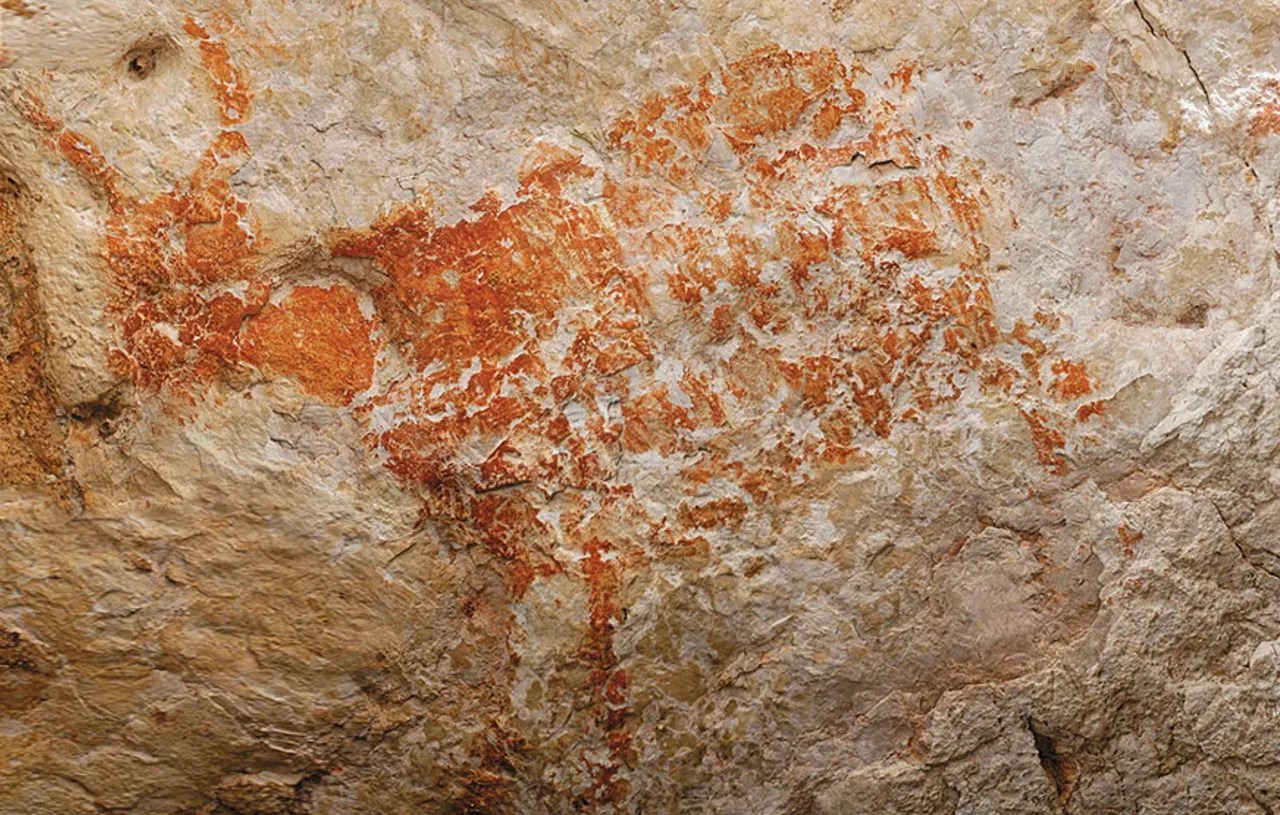
Borneo, Indonesia cave art. World’s oldest known artistic rendering (c. 40,000-50,000 BCE). Creative commons image
By Terry Poulos, Scientiquity founder
(Editor’s note: This blog was originally published November 13, 2019)
`It’s hard to put into words. You have to see it with your own eyes.’
How many times have we all verbalized those sentiments? Countless. The reality is, some concepts cannot be conveyed by word alone. Maybe the verbiage will be invented some day but until such time we’re forced to `paint you a picture.’ Perhaps there’s sound logic as to why this here scribe evolved into an artist (hold the jokes please!).
An incontrovertible, elementary axiom of science is that the single most vital mechanism of navigation for humans is our eyes. We don’t “see” with echolocation like many marine mammals or bats, albeit sound is an important secondary mode of navigation as is vibration. That said, if we did not visually recognize predators in the three dimensional space we inhabit, we’d have died long ago. If we couldn’t see food, we’d have reached an evolutionary dead-end almost as soon as we arrived.
We also know art stimulates the optical senses, and thus the brain. When we gaze at art, we absorb it visually with our mind’s eye constructing the aggregate image while simultaneously our instincts construct a corresponding gut “mammalian” emotional reaction. That scales up via a fractal-like heirarchy to alter our consciousness. Neuronal links mutate to form new connections – good, bad, or indifferent.
With this knowledge, we ask – is art just a luxury? Or is it a necessity to evolve higher intelligence and a requisite to the future viability of the human species?
The short answers: No, yes, and highly-likely yes. Let’s take a closer “look.”
Mainstream dogma has it that tool-making combined with crude forms of earlyverbal communication were the primary drivers of evolving complexity. However, before any commonly-understood language ever formed, there were only grunts, screams, yelps and what have you. This isn’t what a reasonable person would term “effective” communication considering there existed no group common consensus. There was a ton of miscommunication among neanderthals, to be sure!
Early in the human lineage, the more effective and expeditious mode of communication would easily have been physical gestures, including the use of the face and hands to convey messages. Want someone to come over, simply wave your hands. Hungry? Point to your mouth.
Ergo, visual communication must have preceded the spoken word as the primary method of coordination among hominids. If you were the bold type, you might even call these gestures a form of visual art. Anyone who’s ever played charades can relate. It’s an art! Then would it be accurate to assert that “art” jump-started evolution? Hmm.
Over time, language matured. There are twenty-six letters in the modern English alphabet, exponentially more degrees of vocal chord freedom than the near monosyllabic cave-dwelling homo sapien. Modern humans have at their disposal a million or more words. No more “ug ug, me Tarzan, you Jane” for contemporary suitors, although there are exceptions.
This evolved complexity greatly advanced our ability to express concepts and achieve higher complexity, and invent things that better our chances for survival including weapons, agriculture, and medicine. Nevertheless, the visual almost certainly came before the verbal in communication. To this day, visual imagery still speaks to what auditory wordplay cannot and may never.
Visual representation, in this light, must always be thought of as more than a mere secondary driver of ever-more-complex intelligence. But do we require art? Our very future may depend upon the evolution of artistic expression. If the past is any indication, the answer is a firm yes!
Are not geometers “artists”? From the Pythagoreans to Euclid, Plato’s “Forms” and the seeds of geometric calculus sown by Archimedes, to da Vinci’s depth perception and “smufato” realism, the xy planes of Fermat and Decartes, Mobius involution, full-on Newtonian calculus and Reimannian nonlinear geometry, to Escher’s fractal art and Mandelbrot’s fractal geometry, and all the way through the curved space and hidden dimensions of General Relativity and on through Feynman diagrams and Quantum Electrodynamics, scientists and mathematicians have been and continue to be intuitive visual artists, and always will be.
What do the scientists say?
“The greatest scientists are artists as well.” — Albert Einstein.
“The difference between science and the arts is not that they are different sides of the same coin…or even different parts of the same continuum, but rather, they are manifestations of the same thing. The arts and sciences are avatars of human creativity.” — NASA astronaut Mae Jemison
“Science and art sometimes touch one another, like two pieces of the jigsaw puzzle which is our human life, and that contact may be made across the borderline between the two respective domains.” — M.C. Escher
“Only art and science can raise men to the level of God.” — Ludwig von Beethoven
“I’m convinced that art and science activate the same parts of the brain.” — Nobel Prize winning theoretical physicist Frank Wilczek
We’ve now come full circle where visual artistry is arguably on equal footing as an evolutionary stimulus (although it never really did take a back seat). When the world is at a loss for words or equations or philosophical insight, the `visualist’ steps in to fill the void. Visual imagery was the alpha of our initial evolution and remains the stop-gap for all that cannot and may not ever be expressed in the spoken word or via mathematical symbolism.
In this way, the future of the human species is inextricably linked to art. Evolution of complexity in the human organism is reliant on the art of the optical senses. And with that, art is not nearly “just a luxury.”
“Discus Refractus” by Scientiquity, on display outdoor art exhibit in Greektown Chicago. Fractal design
Terry Poulos is a Chicago-area writer, archaeological historian, artist and geometer whose investigations focus primarily on physics, fractal topology, and Number Theory
By Terry Poulos, Scientiquity founder (originally published 12/10/2019)
What is the `stuff’ that constitutes the universe? Scientists, mathematicians, and philosophers – theologians too – have debated this since antiquity. There clearly is no tidy consensus. Nevertheless, let’s see if we can conjure up some semblance of what it most likely could be.
We can see the universe and its colors by virtue of light (electromagnetic waves) that meets our eyes, leading us to believe some of that stuff is at least partially a painting. The universe is also tactile. We feel it with our hands and every inch of our bodies, thus sculpture. We can also hear it with our ears and feel its vibration, indicating it could be a gigantic symphony.
Let’s begin with sound, or as physicists call it “resonance.” If the universe is a musical instrument, what type of instrument? String theory is one of the most studied and well-funded areas of theoretical physics. Some `first stringers’ might claim the universe is a guitar or violin to be strummed. String theoretic conjectures speak of tiny hidden-dimensions (10, 11, 24, 26, or 27 total in many models, with 3 visible macro dimensions) that vibrate to produce a zoo of particles. This is the matter we perceive. Which kind of particle depends on the frequency, angle, charge and momentum at which strings vibrate and interact. Mathematicians call it an integral. These are the “degrees of freedom” of dimensional configuration.
The Pythagoreans (c. 4th century BCE) may have inadvertently laid the foundation for string theory. Aside from inventing Number Theory and studying primes, which they imbued with an almost mystical quality and quantity, they were also inspired by the melodious overtones of the lyre, an ancient hybrid harp-guitar. They viewed these proportions as mathematical beauty that sprang from the spacing of notes. Some notes produced tones that are most pleasing to the human ear (E.g, an eighth or a fifth). The ratio between notes, they claimed, produced a system of harmonics that transcended all universal truth. But if the universe vibrates (note: it does), would not a more appropriate analogue be a saxophone or clarinet? To hear sound, there must be a medium to carry the vibration of molecules from emitter to receiver. That medium is air, ergo wind instrument. In any event, an emitter and a medium are both required, unless the medium is the emitter. Beethoven need not roll over just yet! The ancient Lyre (wiki commons image)
Certainly, there is also a picture to be seen. Everywhere appears a luminescent color palette, the visible portion of the full spectrum of electromagnetic waves. Light emanates from electrons. All atoms have electrons. Even the lightest element, hydrogen, has at least one electron. When an electron is disturbed from its orbit around the nucleus of an atom (orbit is used loosely here), it can dislodge. When this happens, an excitation of energy is produced. This energy is what physicists call a photon (light). The question becomes, if electrons and their constituents – ever more smaller particles such as quarks – are merely vibrations of even more elementary string-like entities, how can we confidently proclaim the universe is a painting opposed to a symphony of myriad resonant activity? Maybe Van Gogh cut off his ear to spite his eyes!
As for sculpture, there are mountains and landscapes we have touched. Humans have stood ground on the surface of the moon. We’d be fools to deny there’s a topological `condensed matter’ of some sort that manifests in our perception of the space we inhabit. Yet, what is space? Einstein’s equations for the Theory of General Relativity predicted that space is curved and that all mass (and light, which is said to be “massless”) follows the geometry that condensed matter carves out. You might call this geometry a sleeve. Einstein predicted that even massless light from far away stars would be displaced by our sun’s (call it gravitational sleeve) to approximately 1.7 arc second degrees. In 1919, a solar eclipse experiment proved this calculation physically to near exact precision, making Einstein an overnight international sensation. Space is absolutely curved, or you might say sculpted. In this way, the universe can be articulated as Michaelangelo’s pieta, David.
There are elements in each argument that make intuitive sense. The universe is translated to our senses through a mechanism that is one part harmony, one part visual, and one part tactile, which coincidentally matches the number of familiar dimensions in which we are free to roam. The universe created its own genre of art and if there is a grand designer, all of ontology is its unique masterpiece.
Terry Poulos is a Chicago-area writer, archaeological historian, artist and geometer whose investigations focus primarily on physics, fractal topology, and Number Theory
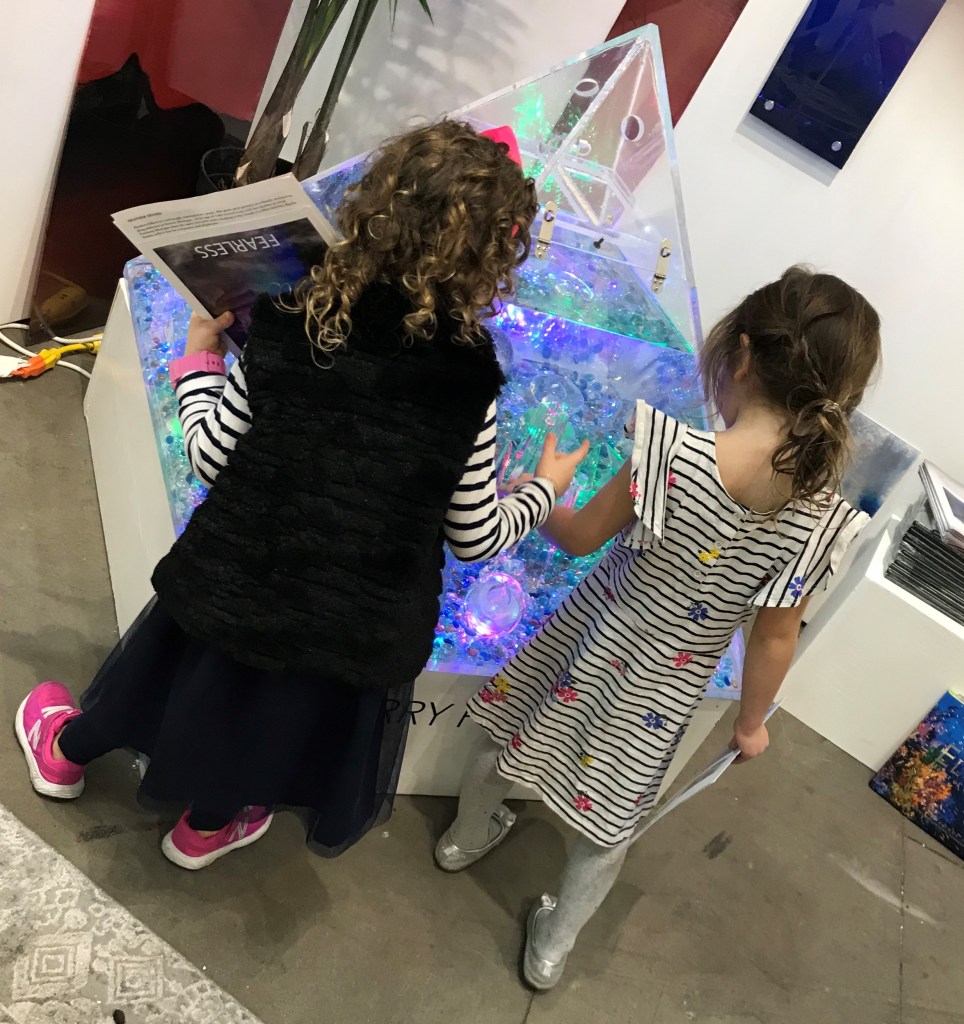
Sophisticated little art critics soak up “Hydromeda Atlantis” at SOFA 2019. For video of the kinetic light art, see Scientiquity’s YouTube Channel
(Editor’s note: This blog was originally posted on November 5, 2019)
[NAVY PIER, CHICAGO]. There are few things that bring more joy to an artist than seeing a child’s face light up as they’re dazzled with wonder by something you created. Sure, all artists want critical review from adult experts, not to mention commercial success. That’s a given. But children, oh that’s something extra special. They’re pure and innocent, untouched by the bias of nurture and experience. They react out of reflex. When they beam, it’s genuine and from the heart. It’s real!
That kind of critical review touches an artist with an inner warmth unlike all the riches could ever bring. Many times last week, I was gifted that privilege. And each time it made my eyes a little misty. It felt as though I touched their mind and soul. But did it launch a cascade of neuronal connections and re-connections? Did it inspire them to greater things? It sure is wonderful to move people with aesthetics. That’s the primary function of art. Or so they claim. Granted, Scientiquity art is science and math-based, thus carrying with it an educational narrative. But how tangible is the reach of art?
This all started with an invitation at the behest of Arica Hilton, a globally-recognized artist who’s had her paintings exhibited all over the world. She’s also the atelier and owner of the longtime River North, Chicago gallery Hilton-Asmus Contemporary.
Arica asked me to exhibit my sculpture Hydromeda Atlantis (video below) at her booth at this year’s SOFA show (Sculptural Objects & Functional Art) at Navy Pier along with her own line of paintings titled “Flow Like Water.” SOFA, held this year October 31-November 3, attracts more than 30,000 attendees annually, making it one of the largest such art exhibitions nation-wide, second only to Art Basel in Miami.
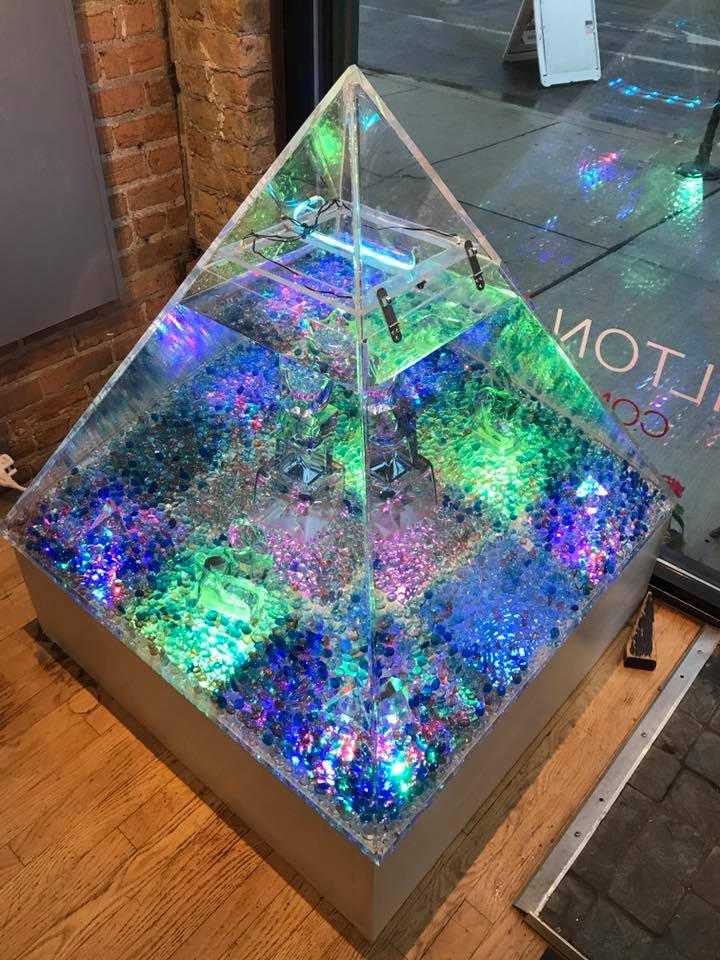
Hydromeda Atlantis is a world-first kinetic light, under-lit aquarium sculpture. Light reflects and refracts off myriad glass, naturally-occurring geometric objects that fill the 70-gallon acrylic container. At three feet in height, this pyramidian approximates the dimensions of the missing capstone at the Great Pyramid of Giza.
Back to the future, the kids. I must concede, it’s almost impossible to pinpoint whether this was anything more meaningful than a simple `wow’ moment in the soon-to-be long journey through a child’s life. At SOFA, we had the opportunity to conduct an impromptu experiment with one adorable little 10-month old toddler. Quiet as a mouse, she was held for a minute in front of Hydromeda Atlantis, stared at the pyramid but showing no noticeable reaction, nor did she utter a sound. When she was sat down on the floor directly in front of the sculpture, about a half minute elapsed when all of a sudden she reached out, pointed at the alluring light show and proclaimed with an excited tone “da.” About five of us witnessed the event and we all got a good laugh. I’d like to think the art elicited the response. It sure seemed like it.
There were more similar encounters. Friday was the day they bus in student artists from around the region. Hoards of aspiring young artists were exposed to Hydromeda Atlantis, marveling at the unique kinetic light display. And on at least two occasions, we spotted adolescent-age kids grabbing their parent by the arm or hand and literally dragging them into Hilton-Asmus’ booth #49, demanding to see up close the never-before-witnessed new genre of art.
Anecdotal evidence aside, science does say visual stimulus alters our consciousness. Every new experience changes us, takes us in another direction. When we’re stuck, we require that something extra. Almost all the great innovators in science, mathematics, technology and the humanities shared at least a modicum of love for the arts.
But, alas, perhaps I wish too much. It’s art, after all, and the machinations of the reality of the business world grind render art mostly a “luxury.” But is it just a luxury? We’ll save that for next week’s blog post. In the interim, we’ll leave you with this one quote to chew on until then.
“The gift of fantasy has meant more to me than my talent for absorbing positive knowledge.” — Albert Einstein
A wide-eyed child with her hand in the Hydromeda Atlantis “cookie jar”
* Many thanks to Hilton-Asmus associates Sven, Matt, Kate, Max, Jason, Lourdes, and Beth for their assistance last week. I owe you all. Much appreciated!
* I bought out the entire inventory of 3-gallon water jugs at the local Target, not to mention a few other items. Art may stimulate the imagination but it also stimulates the economy, to be sure
* Hosting an event of this magnitude, with more than 30,000 attendees, is a massive undertaking and the staff at SOFA and Navy Pier, along with the many carpenters, electricians and other hard-working personnel whose efforts are requisite to putting on such an exhibition, could not have been more kind and helpful. Just take a look at the photo below to get an idea of the sheer size of the venue. This is only about one-third of the entire layout
Navy Pier, Chicago. Set-up for SOFA 2019
Terry Poulos is a Chicago-area writer, archaeological historian, artist and geometer whose investigations focus primarily on physics, fractal topology, and Number Theory











 Scientiquity
You must be logged in to post a comment.